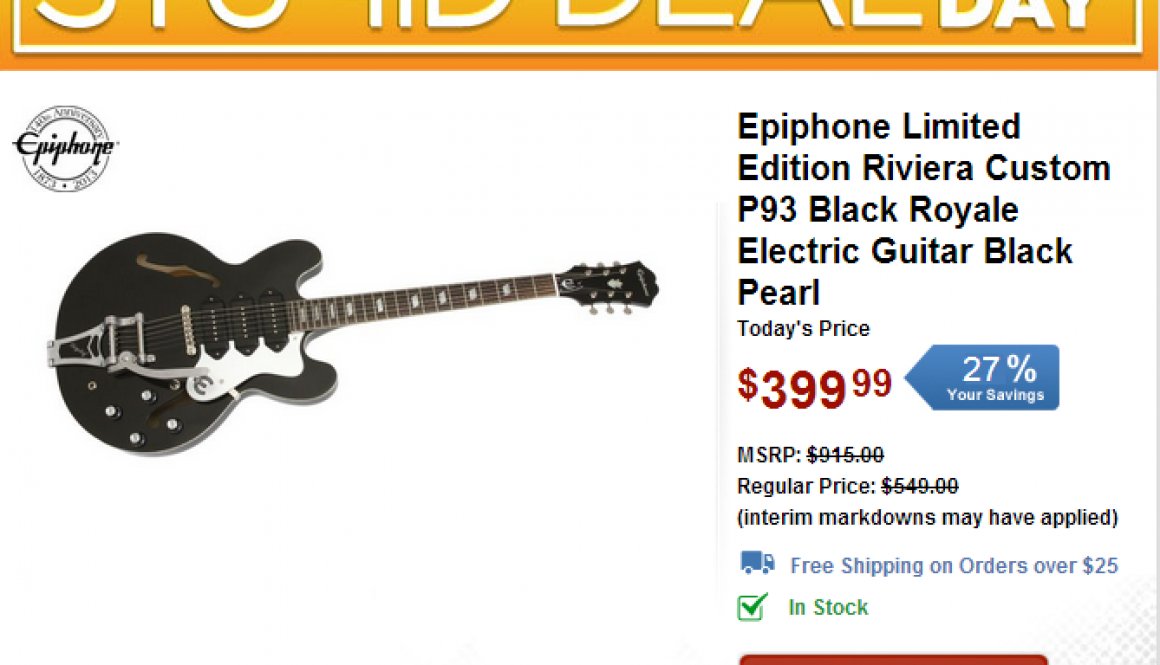
Epiphone Riviera P93 Stupid Deal

I just love Musician’s Friend Stupid Deal of the Day.
Right now, for one hour only (until 8am PST), they have the Epiphone Riviera P93 Black Royale, for only $399, shipped free. You’ll never find a better deal on it.

I just love Musician’s Friend Stupid Deal of the Day.
Right now, for one hour only (until 8am PST), they have the Epiphone Riviera P93 Black Royale, for only $399, shipped free. You’ll never find a better deal on it.

 My pedal board is flush with overdrives, but sorely lacking in distortion. I’ve never loved my RAT – it has scurried on and off my pedalboard over the years, never finding a permanent home there. I’ve really been needing a solid traditional distortion lately, to use with my band covering tunes by Green Day, Blink-182, Weezer, etc.
I love my Vox Ice-9 overdrive, so I decided to try out the Vox Satchurator. It’s apparently a boutiquey version of the classic Boss DS-1. When I received it, I immediately plugged in and lost myself in its glorious tones for an hour or so. It sounds really really good. Very different from my overdrives and fuzz. It has a big, saturated, overtone-rich distortion. Excellent for thick heavy leads, but also equally good for massive chunky rhythm.More
 I’ve been using the same Dunlop 44P textured .60mm grey nylon picks for the last 20+ years. I’ve tried tons of other picks (mostly freebies I picked up at the NAMM show), but I tend to always come back to these Dunlop 44P’s.
Unlike with smoother picks like the Tortex, I find that I never really drop these. I have one of those Dunlop mic stand pick holders, and I dutifully load it up with 3 or 4 picks at the beginning of every gig and rehearsal. But honestly, I have never, not even once, needed to reach for a replacement pick!
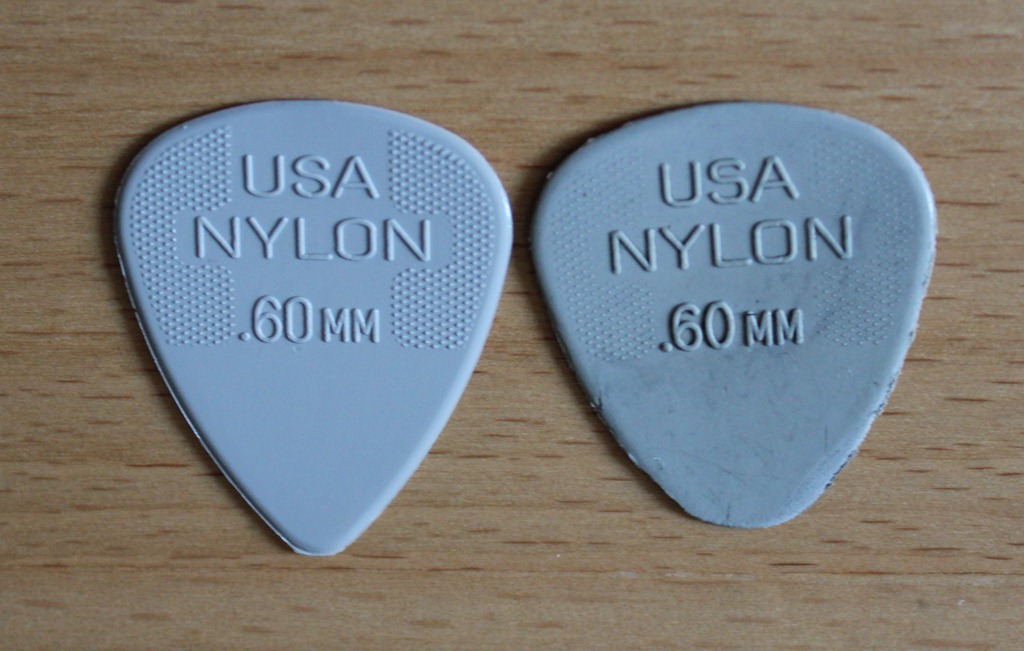 I change strings every couple months- more often in summer, when I’m playing in sweaty situations. But it has never really occurred to me that picks also get worn out and require changing.
I’ve always thought these picks would just last forever. But I recently ordered a new 12-pack, and was amused to see such a big difference.
I hadn’t realized that these picks I had been using were so ridiculously worn out! The new picks have a more clearly defined (undamaged) bottom edge, so they dig a little deeper when picking. Practicing with those worn picks, I’m actually getting used to holding my picking hand at the wrong pick-depth – not good! Time to throw away these old picks!
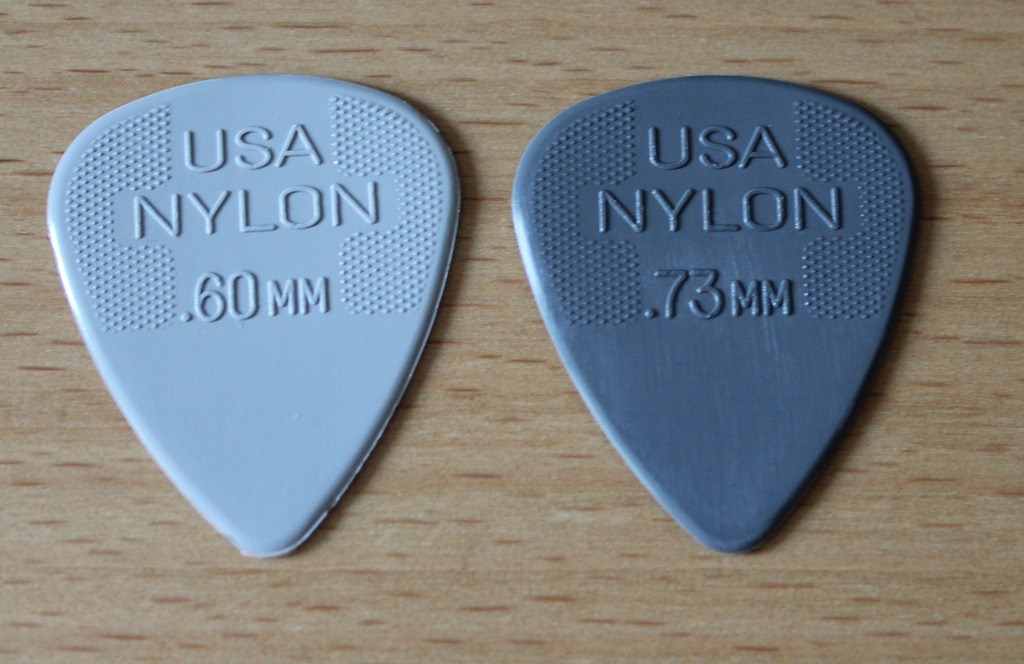 In years gone by, I was always a rhythm player- and the .60mm was the perfect pick gauge. But I’m starting to realize in my role as lead guitarist in the Drop Daddies, that a thicker pick may be a better fit. I just got a set of .73mm picks to try out, with the same Dunlop 44 tactile grip. They definitely feel different – more aggressive. I think I like!
In this article, Pete Biltoft at Vintage Vibe Guitars describes the various causes of guitar feedback, both good and bad, and provides some suggestions for eliminating unwanted feedback.
Thanks again to Pete for the permission to post this here!

June 2013
Howdy!
Feedback: when it is used in an appropriate, controlled manner it can be glorious; when it appears unwanted it is about the worst sound ever. In this Tech Tips newsletter both types of feedback will be discussed.
Let’s start with the undesirable out of control high pitched screech we want to eliminate, and then move on the good stuff.
Unwanted microphonic feedback in guitars with magnetic guitar pickups usually arises from one or more of the following sources listed below. With each of these sources I have added suggestions in italics for eliminating the associated feedback.
Vibration of the coil windings inside a magnetic pickup. Most modern pickups are potted in molten wax under vacuum to reduce the possibility of unwanted microphonic feedback.

 Lester Polsfuss passed away at the age of 94 after a fight with pneumonia on August 13, 2009. Nearly 3 years later, the property from the estate of Les Paul went up for auction in Beverly Hills, CA.
The auction company put together a beautiful 400 page book listing the items of the estate. In case they end up taking down the book, I have saved the PDF here (68MB) for posterity.
The estate items range from the awesome, to the slightly disturbing, to the nostalgic and the just plain silly. Let’s take those in order:
Man, did Les Paul have an amazing guitar collection!
 In addition to the gorgeous specimens from Gibson and Epiphone that you would expect, you’ll also find lot 722- a 1951 Fender No-Caster signed by Leo Fender (valued at $40,000-$60,000). It actually sold for $180,000 (!) as documented in this handheld video from the auction floor. That’s some kind of crazy, right there.

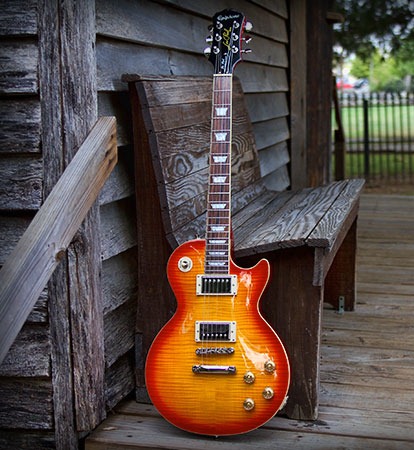 After nearly a year, I’m still loving my Epiphone Les Paul 1960 Tribute Plus. I‘ve played a number of gigs with it and it has proven itself absolutely reliable and roadworthy. It has really excelled in every situation – loud indoor gigs, scorchin hot outdoor summer gigs, and of course my everyday practice, both unplugged and amplified.
This model seems to be a diamond in the rough at Epiphone- a truly great collection of features, including the awesome Gibson ‘57 Classic pickups, for a very competitive price.
 I’ve often wondered why I haven’t seen Epiphone really promoting this model as much as it deserves. Well today, I noticed that it’s currently featured on the front page of Epiphone’s website, as part of their 140 years (1873-2013) anniversary. There’s a nice write up with a few choice quotes from Les Paul, and some gorgeous pictures.
Maybe they’ve finally decided to seriously promote this gem of a guitar!
In my series on building your own iDevice Guitar Interface, I demonstrated an interface which connects through the headphone/microphone jack. This is similar to the commercial products like IK Multimedia Amplitube iRig, Peavey AmpKit Link, Griffin GuitarConnect. And like all those, it works well, but it is not the most high-fidelity solution.
There are also a number of products that instead connect using the dock connector on the bottom of the iDevice, for example the Apogee Jam, Sonoma GuitarJack, Alesis iO Dock and Line 6 Mobile In. These interfaces have their own A/D converters, and pass the signal digitally to the iDevice providing higher quality audio. The downside is that you can’t charge the iDevice on battery while using the interface, which may be an issue for live performance and recording.
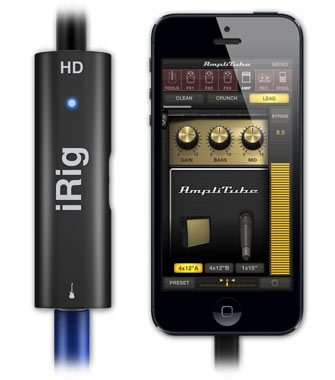
There’s a new contender in the dock-connected interfaces, and it looks pretty nice: the IK Multimedia iRig HD. In appearance, it looks very similar to the Apogee Jam. I prefer this style of interface, rather than the Sonoma, and Line 6 approach which have the entire unit hanging off the dock – that seems very precarious and likely to break the dock.
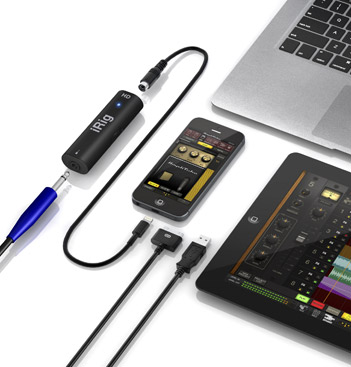 Also, at $99 the iRig HD is cheaper than the $129 Apogee Jam. If you have a newer iDevice with the lighting connector, the iRig HD is an even better deal, as it includes the lightning adapter cables as well as the older-style 30-pin connecter, and also a USB connector for use with a computer.
All that said, I’m perfectly happy with my DIY interface for practice, but if I was using it for recording or live performance, I might consider buying this iRig HD.

In pedal building, we almost exclusively see the Hammond-style diecast aluminum enclosures. You know their names- the ubiquitous 1590B (aka 1290NS) and its plus-size cousin the 125B. Then there’s the larger 1590BB, and the tiny and temperamental 1590A. What these all have in common is the simple generic rectangular shape.
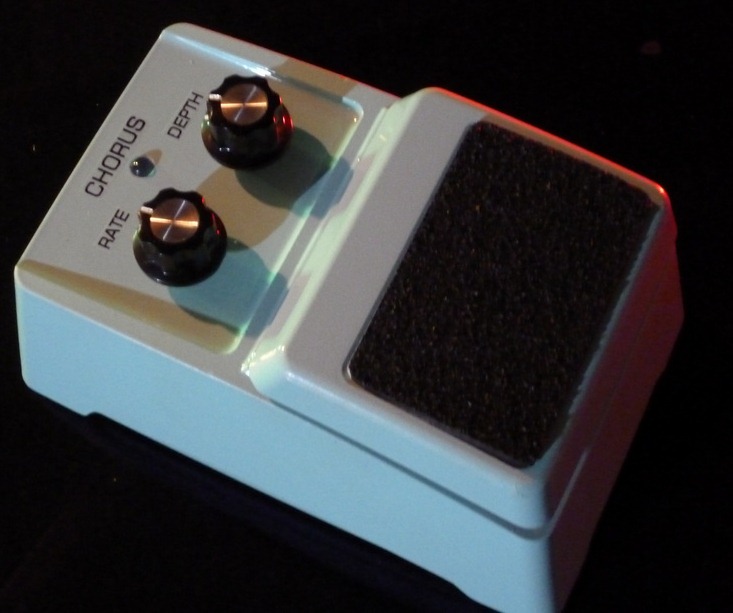 But what if you’re a fan of the spring-loaded foot-pedal enclosures made famous by the BOSS and Ibanez pedals?
Typically, the only way for DIY pedal builders to achieve that look was to buy an old pedal and gut it- but then you’re stuck with the original pedal’s drilling layout.
Now there’s a new option- I just came across these new enclosures from Rixen Pedals.

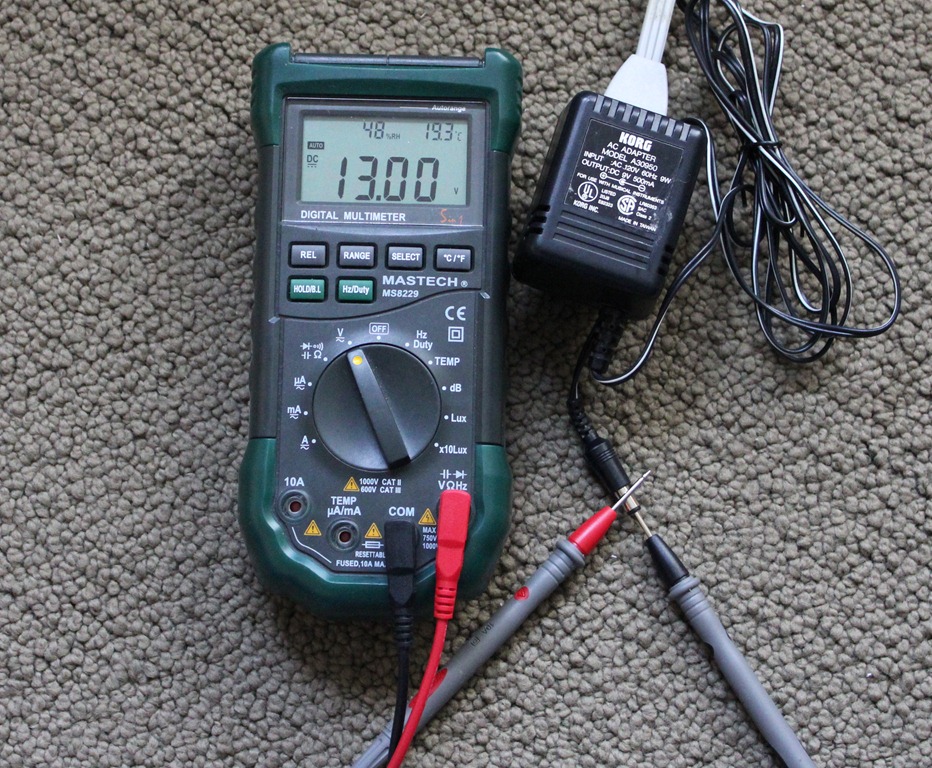 Answer: when it’s 13V!
As I mentioned previously, my pedal board’s power supply died, so I’ve been temporarily using an old Korg 9V power supply.
I’ve been getting some hum from Ryan’s Fulltone Fat-Boost, and finally decided to do some sleuthing to figure out why.
Fortunately, before I even cracked open the Fat-Boost, I hooked up a multimeter to measure the voltage output of the Korg supply, and it turns out that this little guy is really putting out 13V, not 9V. Well, that’s annoying. Is it mislabeled, or just over-compensating for something?More

 The night before my St Patrick’s Day gig with the Drop Daddies, we were setting up at a rehearsal space for a last minute practice. I powered up my gear, and none of my pedals were working!
After a bit of trial and error, it was clear that my ancient SKB PS-25 pedalboard power supply had finally keeled over. I never use batteries, but fortunately a couple of the pedals had old 9V batteries still in them, so it was enough to scrape by for the rehearsal.
 The following morning, just a few hours before the gig, I went through my box of old guitar gear to try to find a replacement 9V DC negative-tip power supply.
Hey, here’s the power supply for my Digitech Jamman Delay which I’m not currently using in my live rig. It says 9V, 1.3A. Strange, it doesn’t show a polarity, but it’s a power supply for a guitar pedal, and the plug barrel fits, so it must be good, right? What could possibly go wrong?