
|
articles etc site
contents |

Lately, I've been rediscovering science and physics - subjects which I was never really excited about back in school. My turnaround is attributable mostly to my interest in Richard Feynman. He was a brilliant physicist whose books and lectures make learning science a joy. If I had been taught in highschool by a teacher like Feynman, I'm sure I would have become a physicist.
Update September 5, 2003: Wow, 5 years since my first topic here. I'm still learning new stuff all the time, just not taking the time to write it all down. Lazy me! I just discovered a great series of video lectures at MIT, by the professor John Belcher. I've watched a couple, and he's a great teacher. See them here (click on "Video Lectures").
Cool science things I learned lately:
| Using the sun as a telescope lens |
| How difficult was it for the first life to appear on earth? |
| Why does ice float in water, and who really cares anyway? |
How was the mass of the Earth first determined?
In 1798, Sir Henry Cavendish did an experiment to test the effects of gravity on the small scale - for example two lead balls on either side of a rod hanging on a thin thread. By measuring the minute twisting of the thread, Cavendish was able to determine whether Newton's law F = (GMM')/R^2 was still true on a tiny scale. Also, since he knew both lead ball masses M and M,' and the distance between them R, and since he could meaure the force F, he was therefore able to determine the constant of gravitation G. See here for a diagram of this experiment.
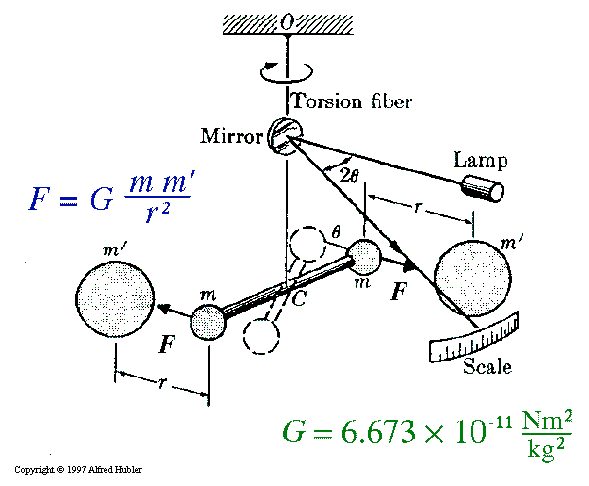
Cavendish called this experiment "Weighing the Earth" instead of something like "Measuring the constant of gravitation". Why? No one yet knew the mass of the Earth. It is an easy experiment however to determine the gravitational force on an object at the Earth's surface (4000 miles from the center of the Earth, a mass falls about 16 feet per second). So in the equation F = (GMM')/R^2, the force, distance and one mass were known - but only the combination GM was known, not what the values were individually for G and M (where M is the mass of the Earth). Now that Cavendish had found G, he could plug the values into Newton's equation, and out popped the mass of the Earth.
(Source: Feynman's Messenger Lecture: the Law Of Gravity)
How was the speed of light first determined?
In 1676, Ole Christensen Roemer was observing the orbits of the moons of Jupiter, trying to determine if those too followed Newton's law of gravity. He found that, suprise, they didn't! It appeared the amount of time it took for the moons to travel around Jupiter varied. Then he realized that these times varied with the distance between Jupiter and the Earth, taking longer when Jupiter was farther away from Earth. Roemer, so convinced that Newton's law must still be correct, proposed the idea that light was not an instantaneous phenomenon - that in fact, light travelled at some finite speed - this was the first time that anyone proposed such a concept. He calculated the speed of light, based on the variances in the orbit times of Jupiters' moons, relative to the distance from Jupiter to the Earth. His calculations were not very accurate (he was about 40,000 miles per second off), but it was a remarkable discovery nonetheless.
(Sources: Feynman's Messenger Lecture: the Law Of Gravity, and Stephen Hawking's Brief History Of TIme)
Using the sun as a telescope lens
According to Einstein's theory of relativity, massive objects warp spacetime. Light travels in straight lines as everyone knows, but when light passes by a massive object, the light follows the "dent" in spacetime, and therefore ends up being deflected a little bit. Einstein predicted this, but it wasn't confirmed until 1919 when Sir Arthur Stanley Eddington made observations of starlight near the sun during a total solar eclipse, verifying a small deflection when compared with the star positions in their usual not-passing-by-the-sun positions.
Extending this idea, we can think of the Sun as a giant lens, focussing inward the light which passes it. As the deflection isn't very great, the actual focal point is some 51 billion miles away from earth. However, if we carried a little receiving dish to the right location, and collected the light focussed there, we would be able to see further into the reaches of the universe beyond our sun than ever before.
This gravitational lens phenomenon was observed by the orbiting Hubble telescope in several cases where distant light reaches us after having passed by some massive object (like a galaxy). Here are some NASA press releases with incredible Hubble photographs:
Gravitational Lens in Galaxy Cluster Abell 2218.Cross-shaped Gravitational Lens
Gravitational Lens Captures Image of Primeval Galaxy
Hubble Astronomers Use Lens In Nature To Uncover Most Distant Galaxy In The Universe
(Sources: Frank Drake's Is Anyone Out There? The Scientific Search for Extraterrestrial Intelligence, and Clifford Will's Was Einstein Right? Putting General Relativity to the test )
Update May 18, 1999: CNN article with pictures of many Hubble-discovered lenses
How difficult was it for the first life to appear on earth?
In 1951, Melvin Calvin (1961 Nobel prize in Chemistry for his work on photosynthesis) performed a simple experiment in which a gaseous mixture of simple molecules (carbon dioxide, hydrogen and water) were blasted with electricity, causing them to fuse into formaldehyde, glycolic acid and formic acid. This experiment was intended to simulate an environment that might have existed in the atmosphere of earth, before life existed. A cloud of simple molecules being bombarded with lightning. Calvin showed that indeed carbon-based organic chemicals can relatively simply result from such and environment.
Then, in 1953, Stanley Miller and Harold Urey performed a similar experiment. They filled a flask with a set of gases (water, hydrogen, methane and ammonia) thought to represent the early pre-life atmosphere of earth, and then gave it a jolt of electricity (a la lightning). See diagram. They found that the results contained not only organic molecules (as in Calvin's experiment) but also amino acids - the fundamental ingredients for life on Earth.
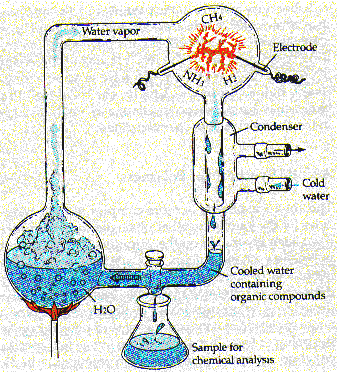
The conclusion was that, in fact, it must have been relatively simple for life to appear on Earth, given the right set of gases, some electrical atmospheric activity and plenty of time. Frank Drake's conclusion is of course that there must be many cases in the universe in which similar conditions have led to life. Whether that life is intelligent is another question...
(Source: Frank Drake's Is Anyone Out There? The Scientific Search for Extraterrestrial Intelligence)
Update February 19, 1999: A new variation on the Miller/Urey experiment shows that life may have formed in space, and arrived at earth via meteorites. Read the CNN article.
January 10, 1999
Why
does ice float in water, and who really cares anyway?
This is a trivial sounding question, but in fact, ice floating in water is an exception to a general rule that the solid form of a substance is more dense than its liquid form (and therefore the solid sinks in the liquid).
As the temperature of water decreases, its volume increases, as you would expect - at 100 degrees C the volume of a single gram of water is 1.043 cubic centimeters, and at 4 degrees C, the volume has contracted to 1.000 cubic centimeter, increasing its density. However, as the temperature drops below 4 degrees C, the density starts to decrease so that at zero degrees C, the volume is 1.001 cubic centimeters (a density of 0.9999 grams per cubic centimeter). If the temperature keeps going down, the water obviously becomes solid ice, but the density continues to drop, contrary to what you'd expect. As ice, the density of water is only 0.92 grams per cubic centimeter, significantly less than the density of liquid water. So if an ice cube is placed in a glass of water, 92 percent of the ice will be below the water, and 8 percent will remain above the surface. Hence the expression, "the tip of the iceberg".
Who cares, you ask? Life as we know it could not exist on earth without nature making this exception for water! When a lake freezes over, the surface freezes first, and since ice is a good insulator of heat (think of living in an igloo), and since ice floats on water (as described above), the water beneath the icy surface stays liquid. This allows the living creatures beneath the surface to survive until warmer weather returns. If water behaved like other substances, then as the lake surface began to freeze, the ice would sink to the bottom, allowing the surface to continue freezing until the lake was frozen solid. All life in the water would perish in such a situation. Imagine if the oceans had frozen solid every winter - life as we know it would never have evolved on earth!
(Source: Isaac Asimov's The Left Hand of the Electron)