
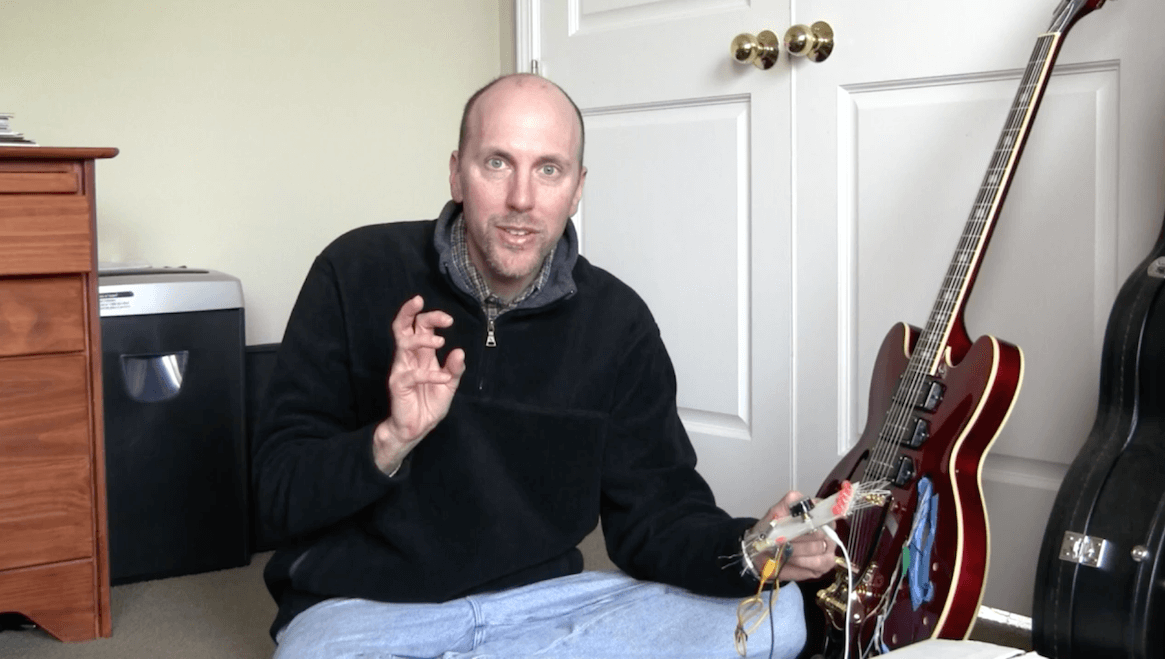
Tone Caps Follow-up
I’ve received a lot of questions and comments about my tone cap videos part 1 and part 2.
In this video (split into two parts due to YouTube length limits), I answer some of those questions, and record some more examples. I talk about 50’s versus modern wiring, my recording setup and how the audio is processed, and how to do double-blind testing. I measure the cap values, and record another set of examples, now including ceramic caps and distorted examples.
Correction: in the video at 3:34, I misspoke- the cutoff frequency doesn’t actually change. Just the amount of signal passed through the cap. On 10, very little signal passes through the cap to ground.
April 13, 2010 @ 1:36 pm
April 13, 2010 @ 1:42 pm
thing to change the resolution to 480i.
April 13, 2010 @ 5:08 pm
April 13, 2010 @ 8:44 pm
resource for me. i recently replaced the electronics in an old 80s MIJ
strat of mine. your videos were such a huge help. nothing else i found (and
i searched quite a bit) was nearly as helpful. thank you.
April 14, 2010 @ 1:11 am
Like tone? In depth capacitor comparison: - My Les Paul Forums
April 13, 2010 @ 10:24 pm
[…] capacitor comparison: John has posted a follow up, now including examples with distortion. Tone Caps Follow-up lanet z __________________ my wunnerful melody maker (dual pickup, […]
Like tone? In depth capacitor comparison: - My Les Paul Forums
April 14, 2010 @ 2:28 am
[…] capacitor comparison: John has posted a follow up, now including examples with distortion. Tone Caps Follow-up planet z __________________ my wunnerful melody maker (dual pickup, […]
April 14, 2010 @ 2:20 pm
can handle before the dialectric breaks down. the voltage of the guitar
signal is tiny (probably milliivolts), and these caps have pretty high
ratings (sometimes in the hundreds of volts), so it’s not something to
really worry about.
April 14, 2010 @ 2:27 pm
relatively short so you can easily A/B them. but it would be useful to hear
the entire range of the guitar played at several different resistance
values, at several different picking intensities, for every cap. it would
be a huge effort though, and hard to compare them. in any case, i’ll leave
that as an optional exercise for the truly obsessed 🙂
April 14, 2010 @ 6:30 am
Thanks again john. Your four parts on this topic are the most definitive investigation of capacitor and tone, ever known to mankind. You should get a webby award or something.
April 14, 2010 @ 7:48 pm
April 14, 2010 @ 10:14 pm
Is Tone Love Blind? :planet z
April 15, 2010 @ 8:49 pm
[…] are the recordings lifted from my most recent Tone Cap Comparison Video, split into individual files. The files are named using generic numbers, rather than labeling […]
April 16, 2010 @ 10:42 pm
caps!? That would be interesting!
April 18, 2010 @ 11:36 am
I am skeptical, and didn’t expect to hear differences, but I could detect some between caps once I did some intense A/Bing.
I did a blind “tournament” bracket listening test (1v2, 3v4, etc and then compared the winners) with both clean melody and rhythm clips. I found I preferred 1, 4, and 6 for both tests in the first round, and 1 and 6 both times in the second round (not really liking 7 or 8 much out of the bunch). 1 and 6 are the Orange Drop (which is what I already use in most of my guitars, so maybe familiarity comes into play) and 6 is the NTE ceramic (I’m a cheap date, I guess).
BUT I then compared the “measured” capacitances, and in every first round comparison I tended to prefer the one with the lowest measured capacitance! So this doesn’t tell me that I can necessarily detect differences in the cap material, but that I tend to prefer the lower value caps.
Great job! There is more “magic mojo” being spewed around the net over tone caps than anything else!
April 18, 2010 @ 7:56 pm
Hey Alan,
Great to hear your results. If it’s not already obvious, I too am inherently skeptical about this stuff- and that’s one of the reasons I undertook this whole project.
Interesting about your preferences matching the lower capacitance measurements. I still really think they can’t be accounting for the total difference in sound character – since in some of the cases I really hear differences in lower parts of the frequency spectrum (lower than the cutoff freq).
To really take it to the next level, I should have carefully tuned each cap test to have the same cutoff frequency. I had considered doing this at first, but it was too much trouble.
So much to do, so little time 🙂
Thanks again for the feedback,
John
April 20, 2010 @ 12:41 pm
cylinder caps? John found it in a drawer at his dad’s house. But I really
liked that one.
May 10, 2010 @ 10:30 am
your next proyect, no one ever on youtube have done that and its really
easy if you just see a fender highway one wiring diagram. If you need any
support on doing this dont worry to ask me.
May 17, 2010 @ 1:05 pm
Great video on tone and caps. Even better is your P93 and VOX, I happen to have one of each also or close. I bought a P93 just like yours at Christmas and a VOX ADVT50. I changed the metal grill and replaced with a diamond cloth. Here’s a link to the AMP (http://sphotos.ak.fbcdn.net/hphotos-ak-sjc1/hs516.snc3/27103_1407191228565_1495973327_1069641_1844064_n.jpg)and also a post I did on doing it (http://music-electronics-forum.com/t7261-post140856/#post140856)
Jim
May 17, 2010 @ 1:26 pm
Hey Jim,
Sweet mod on the amp- looks great!
-John
May 17, 2010 @ 2:21 pm
Thanks
May be you can help me with another thing, a wiring thing. I am going to take some pics and send a link in 30 minutes or so and when you get a chance take a look.
Jim
May 17, 2010 @ 3:57 pm
John
If you have an idea where the yellow wire goes and if the output jack wires are right?
Here the story or setup, this is a Saga ST 10 Kit (Strat Copy) I bought to play with and try finishing and whatever. I put it together and then took apart to do a finish on body. I cut the wires from the output jack and the ground wire. The yellow ground is the wire I forget where it was, the black and white I think are right but could be wrong. I put it all back like I thought it was but no sound. Any ideas?
Here is a picture of the controls and wiring.
Yellow wire is ground coming from claw hook for tremolo springs in back of body (forget where it was soldiered when I got this kit)
http://photos-a.ak.fbcdn.net/hphotos-ak-ash1/hs324.ash1/28364_1449036114661_1495973327_1158937_927337_s.jpg
Here is the output jack.
Black wire comes from output jack and is really 2 wires a white with a ground wire shield around it, if you look where it goes into body there are 2 wires, a black and a white (looks blue from finish paint) The black is center of output jack and white is outside of output jack, see next picture.
http://photos-h.ak.fbcdn.net/hphotos-ak-ash1/hs324.ash1/28364_1449035674650_1495973327_1158932_4424293_s.jpg
Here is where the output jack wires are now.
The controls as they sit in first picture, right next to pickup is volume and the black wire from output jack is soldiered to volume pot shell, white wire is soldiered to the center terminal. The next 2 controls are tone pots.
http://photos-e.ak.fbcdn.net/hphotos-ak-ash1/hs324.ash1/28364_1449035914656_1495973327_1158935_7875592_s.jpg
http://photos-c.ak.fbcdn.net/hphotos-ak-snc3/hs294.snc3/28364_1449035874655_1495973327_1158934_4815786_s.jpg
http://photos-e.ak.fbcdn.net/hphotos-ak-ash1/hs324.ash1/28364_1449035914656_1495973327_1158935_7875592_s.jpg
If you get a chance, Thanks
Jim
May 17, 2010 @ 7:10 pm
Hey I fixed it, thanks and I have you booked marked, there is some good stuff on here. I need to go back over your P 93 pickup change out. I might have some ?? I like the P 93 as is but I may want to do a swap at some point.
May 17, 2010 @ 9:36 pm
Hey Jim,
Glad I could help– haha! 🙂
Enjoy the guitar!
-John
May 18, 2010 @ 6:28 pm
John
No problem, I got it done and learned about the wiring. I don’t know if you are familar with this guy, Deaf Eddie, does Beatle’s Tribute band and all kinds of other stuff. He hasan aswome guitar collection.
http://www.deaf-eddie.net/
He gave me some clues as what to look for to fix it. Hey again I will be looking at your P93 posts.
Jim
June 21, 2010 @ 12:56 pm
Gibson Explorer which is two volumes and master tone. Would that be 50’s
wiring? And for a more vintage tone, what would you think of Sprague
Vitamin Qs? Does anybody know what material that is so I can get an idea of
what it sounds like with the first video? Thanks ahead of time!
June 22, 2010 @ 5:18 pm
June 22, 2010 @ 8:16 pm
June 25, 2010 @ 3:54 am
October 12, 2010 @ 5:49 pm
October 12, 2010 @ 5:50 pm
definitely a difference between the ceramic and the others
October 27, 2010 @ 10:56 am
1S22 Polyester Film capacitor with a 100v rating, from CDE Cornell
Dubilier. You should be able to find some on ebay, etc.
November 3, 2010 @ 5:43 pm
IMO: No variations that couldn’t be made much more markedly at another point in the signal chain (amp tonestack etc.) or picking technique. The differences are effectively inaudible in practical terms. I suppose it should be considered, that many of the legendary guitar performances were done through mylar and ceramic disk.
I guess we all need to think we have an edge. Even if we’d need to tell everyone to be quiet and concentrate whilst we pointed it out.
November 30, 2010 @ 7:13 pm
December 12, 2010 @ 4:20 am
“in the case where we had the tone pot all the way up, the cutoff frequency was pretty high…”
Well that’s not quite correct. The tone pot doesn’t actually do much about the cutoff frq of the tone circuit at all (which is mainly determined by the PU inductance and the cap), it rather determines how much this cutoff will influence the output signal. So it’s natural that changes in the capacitance will mainly influence the midrange rather than treble, even at high tone pot settings.
December 15, 2010 @ 9:29 am
December 15, 2010 @ 10:07 am
January 19, 2011 @ 10:15 pm
Difficult Decisions - Planet Z
February 3, 2011 @ 6:21 pm
[…] And some people can’t hear a difference at all. Just take a look at the comments on some of my capacitor material type comparison videos and you’ll see what I […]
February 26, 2011 @ 1:43 am
From what I can hear I’d have to say my pref’s are for the Orange Cap and
the Russian.
March 22, 2011 @ 7:36 pm
Crazy Tone Thing - Planet Z
March 27, 2011 @ 7:22 pm
[…] See part 3 for a bunch of followup Q&A and some more audio examples. […]
May 30, 2011 @ 10:02 pm
PS I’d love to see a good pickup series, but I imagine that would be expensive to do unless you could get manufacturers to loan product.
May 30, 2011 @ 10:06 pm
July 3, 2012 @ 7:55 am
Hey John,
I would be glad to send you a couple of my custom wound P-90’s for testing if you’d like. I usually use the Alnico 2 for bridge pups and Alnico 5 for the neck pups. Most of the bridge pups I’ve done have been overwound for a hotter pup and the neck pups at about 10,000 – 10,100 winds. Then I wax pot them in my “secret” formula (not really secret though, 20% bee’s wax and 80% parafin). Get me an address to send them and I’d “donate them to the cause”. Thanks for the great videos and keep it up!
July 3, 2012 @ 8:26 am
Sweet! My VVG P-90’s are wound 8,500 on the neck and middle, and 9,500 on the bridge. (Middle is RWRP). And I’ve always wished they were a bit hotter, so your pickups will be interesting to hear!
I’ll send you an email.
-John
June 1, 2011 @ 9:54 am
June 25, 2011 @ 10:28 am
July 1, 2011 @ 9:28 pm
July 4, 2011 @ 2:57 am
July 12, 2011 @ 12:57 pm
July 25, 2011 @ 6:05 pm
July 14, 2011 @ 6:35 pm
July 25, 2011 @ 6:05 pm
July 19, 2011 @ 4:07 pm
August 6, 2011 @ 9:17 pm
August 9, 2011 @ 4:25 pm
August 7, 2011 @ 11:47 am
i’m doing some mods to a telecaster and am not sure how i want to wire it.
i’m using rail pickups, so both are humbucking.
i was going to get a 250k push pull alpha audio pot, with a 500k alpha linear pot, and was thinking of a orange drop cap in the .033uf range.
would you recommend this, and how would 50’s wiring change the tone?
August 9, 2011 @ 4:33 pm
September 6, 2011 @ 4:31 pm
September 6, 2011 @ 4:37 pm
September 8, 2011 @ 11:07 am
September 13, 2011 @ 2:44 am
September 19, 2011 @ 10:36 am
September 20, 2011 @ 8:56 pm
September 25, 2011 @ 8:56 pm
October 2, 2011 @ 12:05 pm
Thank you so much for putting in the vast time and effort this experiment certainly entailed. Rest assured, there are many thousands of us who very much appreciate a high quality test from a knowledgeable “tone scientist” such as yourself….Bravo!!! Looking forward to future experiments…..
October 2, 2011 @ 12:05 pm
October 10, 2011 @ 2:17 pm
November 2, 2011 @ 1:14 pm
“Explodes quite violently when… a polarized version is subjected to reverse voltage.”
Well… there goes that idea.
November 2, 2011 @ 1:16 pm
December 27, 2011 @ 9:49 pm
January 12, 2012 @ 9:31 am
February 9, 2012 @ 9:44 am
February 9, 2012 @ 9:52 am
February 9, 2012 @ 10:07 am
February 9, 2012 @ 10:20 am
February 9, 2012 @ 10:47 am
February 9, 2012 @ 10:50 am
March 27, 2012 @ 4:55 pm
But since we weren’t in that room to hear it at the best quality possible. What conclusions did you come to? What caps are in your guitar? value and type?
did you change anything or were you unmoved by your trials?
Thanks for taking the time, I’m working on my G&L and this was right on topic.
April 5, 2012 @ 5:32 pm
For my Epiphone, you can see/hear my results and conclusions in my video “Epiphone Electronics Overhaul, Before and After Comparisons”.
February 18, 2012 @ 6:04 am
February 21, 2012 @ 6:08 pm
February 26, 2012 @ 3:58 am
February 28, 2012 @ 9:45 am
In the Soviet Union, the right capacitor finds you.
March 14, 2012 @ 10:52 am
March 14, 2012 @ 9:27 pm
http://shop.axegrinderz.com/ has the Russian capacitors you are looking for.
March 14, 2012 @ 10:04 pm
Thanks for the link! I hadn’t seen axegrinderz before- looks like a great resource.
-John
March 17, 2012 @ 4:12 pm
March 25, 2012 @ 11:14 am
March 26, 2012 @ 9:54 am
June 2, 2012 @ 12:48 am
Hi!
Did you measure those caps.
That is, sometimes there are quite noticeable differences of the REAL values of two 0.022 mfd caps.
June 4, 2012 @ 3:22 pm
Yes, I show all the cap measurements a few minutes into Part 3.
John
June 14, 2012 @ 10:28 am
June 14, 2012 @ 10:48 am
July 8, 2012 @ 7:43 am
July 8, 2012 @ 5:13 pm
July 13, 2012 @ 4:36 pm
July 17, 2012 @ 1:59 pm
August 8, 2012 @ 8:35 pm
August 25, 2012 @ 9:16 pm
August 30, 2012 @ 3:08 pm
September 18, 2012 @ 2:06 pm
September 30, 2012 @ 10:59 am
I’ve noticed elsewhere on the web some schematics have fasel or homemade inductors into the ground end of the varitone circuit.
Any thoughts or experience on the matter?
Also, when you wired your varitone, it seems obvious but the tone caps wired directly on the pots would be omitted because of the multi-capacitor knob just assembled, correct?
Thanks for the videos as well.
October 2, 2012 @ 4:21 pm
An inductor in series with a signal will act as a low-pass filter blocking fast-moving signals and passing slow moving signals (which is the opposite of capacitors). A varitone circuit with both caps and inductors will allow a selection of various low-pass and high-pass filters.
October 3, 2012 @ 1:57 am
October 4, 2012 @ 10:33 am
For those not in on the joke, electrolytics are polarized, high-capacitance (generally > 1uF) caps, so not appropriate for guitar tone circuits.
Crazy Tone Thing -
October 11, 2012 @ 2:29 pm
[…] See part 3 for a bunch of followup Q&A and some more audio examples. […]
November 4, 2012 @ 1:37 am
December 2, 2012 @ 2:33 pm
Or just the tones ?
December 4, 2012 @ 1:03 pm
December 6, 2012 @ 12:58 pm
The Idiots could not understand the “try it yourself”advice you gave in the conclusion.
Yet they try to prove that they are smart? Must be members of Mensa.
I think it worked out Great and I tried it. I ended up finding better caps for my Teles. Thanks!!!
December 6, 2012 @ 1:26 pm
What about Ceramics? Sheesh!!!! Thanks for you efforts!
December 21, 2012 @ 7:37 pm
December 23, 2012 @ 6:18 pm
January 20, 2013 @ 9:19 am
January 25, 2013 @ 10:43 am
May 25, 2013 @ 5:38 pm
May 26, 2013 @ 9:11 am
February 13, 2013 @ 12:37 pm
February 19, 2013 @ 1:22 pm
February 19, 2013 @ 1:22 pm
February 27, 2013 @ 9:03 am
March 22, 2013 @ 7:53 am
I have a question, I ordered two Russian Cap K40Y-9 of 0.022uF, their values at the multimeter are 19.94uF and 19.40uF, a little lower than the real 22uF, Is this normal?
March 22, 2013 @ 8:49 am
April 3, 2013 @ 7:38 pm
June 9, 2013 @ 10:20 am
Very well done! very helpful thank you!
Greetings from France
August 17, 2013 @ 12:36 pm
August 20, 2013 @ 11:57 am
August 29, 2013 @ 8:44 pm
Cheers!
August 30, 2013 @ 9:42 am
October 12, 2013 @ 8:06 pm
October 17, 2013 @ 8:18 am
October 18, 2013 @ 4:36 pm
November 5, 2013 @ 2:05 pm
November 24, 2013 @ 9:10 am
dificult to know what they really can do. Off course that they sound
similar, but its in the extreme playing where In my expierience PIO caps
deliver multicolor magic, specilally in high gains, Polipropilene its more
plane and colorless, ideal for metal, but not for rock. Another point here
too, its use a tube amp, in transistor amps the color of the PIO condenser
will be darkened. So..the magic comes with PIO+Tube+Gain. Another point its
that the PIO condenser, like all vintage electronics, need an adjust run
time….some miles before all inside settle at 100%. In poli the settle its
instantaneous, and never get better with time.
December 16, 2013 @ 4:27 pm
conversion and back..in my opinion invalidates any tests.. that’s just my
personal opinion.
January 1, 2014 @ 10:51 pm
decide to use?
January 7, 2014 @ 1:04 pm
First, let me say, I happened upon your video’s while searching for one on
how to clean the pots in my stereo, and ended up watching 5 of your videos.
I have my own rating system for videos on youtube that goes something like
this:
Scores are either plus or minus. This is your score.
1. video quality +
2. audio quality +
3. cinematography +
4. composition +
5. film editing +
6. presentation +
7. articulation +
8. concise +
9. accurate info +
10. educational/entertainment value +
Typically, the high score can only be 10, however, being that these are so
good, I have rated them one point higher.
“These go to eleven.”
Well done Sir.
January 16, 2014 @ 11:41 pm
(with humbuckers)? Thanks
January 17, 2014 @ 8:07 am
If a person does not want to be influenced by the name of the cap on the
screen then they could always close their eyes while listening:-) If
listening thru an I-pad then just put a magazine over it while listening.
In addition, you could use a chronometer to note at what point in time you
most liked the sound then, when ready, just compare with the video.
If you want your brain to better analyze what your are hearing, I suggest
that a person does their listening WITHIN three hours of waking up. The
reason being that one’s ears do not hear certain frequencies as they tire
from use during the day.
In addition, in order to better hear the differences between caps, listen
to the recording in a DARKENED room as it allows your ears to better
“analyze” and “concentrate” on the sound. I’ve never seen a professional
recording studio that does otherwise!
Some people are color blind (they literally cannot see certain colors —
it is called daltonism). Perhaps people who can not hear the difference
between caps (with the Tone TURNED down to between 7 and 8; the amplifier
on CLEAN; guitar with SINGLE coils) are “sound blind”. From experience, I
have found that it easier to hear the differences between capacitors with
single coils. This clip uses P-90s which are single coils.
Rick Mantree (luthier, singer, songwriter)
February 10, 2014 @ 2:51 pm
March 25, 2014 @ 9:06 pm
April 16, 2014 @ 6:14 pm
July 11, 2014 @ 1:27 pm
participants. I missed the fact that the amp was tone set to neutral on
the pots on the amp. of these considerations did I miss the acceptance
that the only changes to true values were those made as each pot went
through the roll off. I am thinking the vox amps are set up with tone
values from l to l0 and not 5 0 5 treble and bass and mid. I missed
the sight of this except that they were not all standing tall or left hand
zero etc. What s the consideration you have towards leaning tone in one
direction to the amp so that its more pronounced if your eqs are set above
or below zero on the amp to start.
July 11, 2014 @ 1:40 pm
would be the ability to show likes and dislikes of the tone quality. All
of your demonstrations show that frequency values are determined by
dominance in the signal and the ability to last in the signal. This I
believe is the answer you seek in how to value a particular pot. How it
holds and release the multitude of frequency values to the ear
July 11, 2014 @ 1:43 pm
favor one over the others. time of frequency domination in the tone
signal it self. How long it last and how strong it sounds as you strike
single tones and chord tones. smooth and rich, or dull, flat all have a
factor in length and strength of each frequency value in the monitor
frequencies you show on the multi scope
July 13, 2014 @ 11:39 pm
October 27, 2014 @ 3:45 pm
First, those are all close enough that I doubt it’s a “significant” factor,
but it COULD be, especially since one famous double-blind test has found
zero audible difference with matched caps. You say there would be less
difference with the tone pot on ten, because quote “the cutoff frequency is
pretty high.”
– Isn’t that incorrect? AFAIK, when you turn the tone pot, the cutoff
frequency stays the same, you’re just changing the AMOUNT of signal to
ground. No?
Anyway, a new test with carefully-matched caps (and maybe two caps from
each brand would certainly answer some questions.
Well, I have no dog in this fight. Luckily, the PIO caps sound like dung
here, and sound identical in that other test, so there’s no point in
wasting money on THOSE, and orange drops (the clear winner here, I think)
are cheap enough not to worry. Again, big props for this very serious &
detailed effort.
December 13, 2014 @ 5:51 pm
now I need to put both in and use a switch!
May 11, 2015 @ 7:22 pm
Thanks alot! Great job
May 23, 2015 @ 1:45 pm
of if this was that and that was this, 6+6 would be 15, an incoming thunder
storm or VLF front may have been coming in which made a difference. I did
find it very interesting about distortion and the like and the
characteristic of different amps on the sound? as you say, plug the thing
in see if one likes it and adjust to suit a person preference, very well
done and excellent video, thanks
June 11, 2015 @ 12:19 am