Friday, August 31st, 2012 at 11:10 pm
This is part 2 of my new series on building guitar effects pedals.
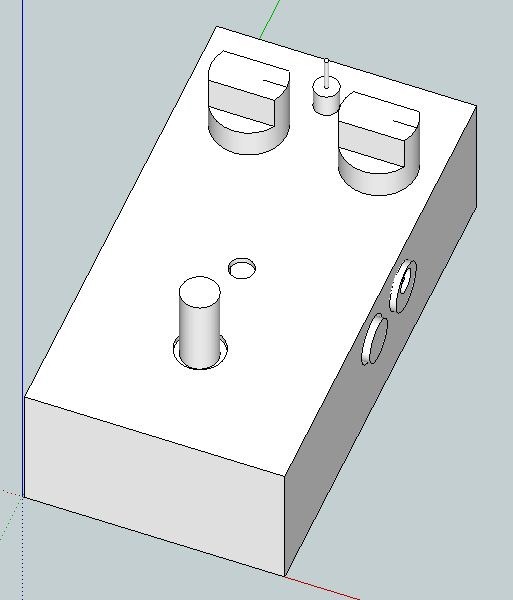
This part of the project ended up being far more grandiose than I originally intended. I started out planning to just show how to model this diecast aluminum 125B guitar pedal enclosure, to make sure my PCB and components would fit properly inside. But by the time I was done with it, it was essentially a complete beginner’s how-to course for Google Sketchup. (Note, Sketchup is now part of Trimble instead of Google).
To give you an idea of how long this took for me to complete, I started filming the intro and the Sketchup tutorial videos in June of 2011. Over the last year, in the time-spaces between the rest of life, I’ve been gradually editing, revising, extending, and composing music for the project.
In this tutorial, I start out with the absolute basics, and gradually pick up the pace, progressing to more and more advanced topics. I divided the video up into 5 sections, but kept them all together in one 55-minute video. In my previous multi-part videos, I had to split them into multiple YouTube clips, due to the YouTube length restrictions, but now that they’ve relaxed those for my account- I hope it’ll be better having it all in one video.
Here is the Sketchup file that I used in the tutorial if you’re interested: Download sketchup file.
Each section assumes a familiarity with the previous section topics. Here’s the table of contents:
Read the rest of this entry
Tuesday, December 29th, 2009 at 11:24 pm
In this video, I finally bring together the results of the last 20 or so videos, and demo the results of my Epiphone Riviera P93 electronics overhaul. I first demonstrate the original Epi setup, then swap in my new electronics, and then replace the pickups with a matched set of new Vintage Vibe Guitars P-90’s.
The new electronics include CTS 500k audio taper pots, no-load mod on the tone pot, an Orange Drop .01uF tone cap, all new shielded wire, and a new Switchraft L12A jack. So, if you’re wondering what it might sound like if you change out your pots and caps in your guitar, this should be a good example. (Note, I’m changing the jack for mechanical reasons, not to improve the sound).
The recordings are made with a Rode NT1 large diaphragm mic, placed 4 inches away from and slightly below center of the speaker grill of my Vox VT30 amp. Read the rest of this entry
Saturday, November 21st, 2009 at 4:59 pm
This is part 5 of the video series on wiring up guitar electronics.
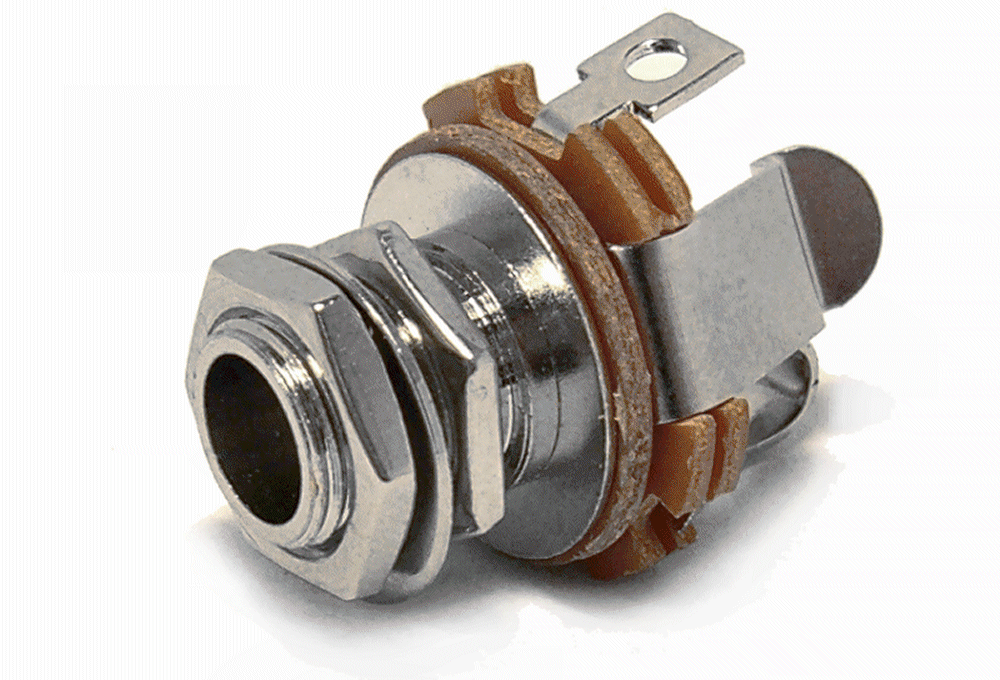
In this video, I show how to wire up the jack. I’m replacing the original Epiphone jack with a Switchcraft L12A. The L in the part number indicates a longer 3/8” bushing, which is just a bit longer than the Epi jack. I’m hoping this well allow me to fit a lock washer in addition to the regular washer and nut, so the jack will stay tightly in place rather than falling into the body of the guitar so much (as I showed in my Don’t Know Jack video).
I also demonstrate how to use a multi-meter to identify which lug should be ground, and which should be signal. My meter is a Mastech MS8229. If your meter doesn’t have continuity mode (beeps whenever a connection is made), you can just use resistance mode and look for 0 resistance to indicate a connection. Note the L12A has a third, middle shunt lug, which you can just ignore.
Friday, September 18th, 2009 at 5:51 pm
What is up with the jacks on these semi-hollowbody Epiphone guitars. When I was shopping for guitars in the stores, I often saw Epiphone Dots and Sheratons with the jack missing inside the guitar. How can that be good for sales?! And when reading in the Epi forums, I saw folks complaining of this happening to them. Does this happen on the more expensive Elite Epi’s, or other semi-hollow body guitars?
I never thought it would happen to me! I made a point of periodically hand-tightening the jack when plugging in a cable, just to be sure.
Read the rest of this entry