Thursday, February 21st, 2013 at 8:52 am
A carpenter once showed me a great trick with a toothpick. One of our doors was sagging, because the screws in the hinges were loose, and couldn’t be tightened. With a glint in his eye, he pulled out a handful of toothpicks from his pocket, saying “my secret weapon”. After removing the loose screws for the hinge, he stuffed a few toothpicks in each hole, cut them off flush, and then re-tightened the screws in the holes. Presto chango- it was all nice and tight. Sometimes the simplest solutions are the best!
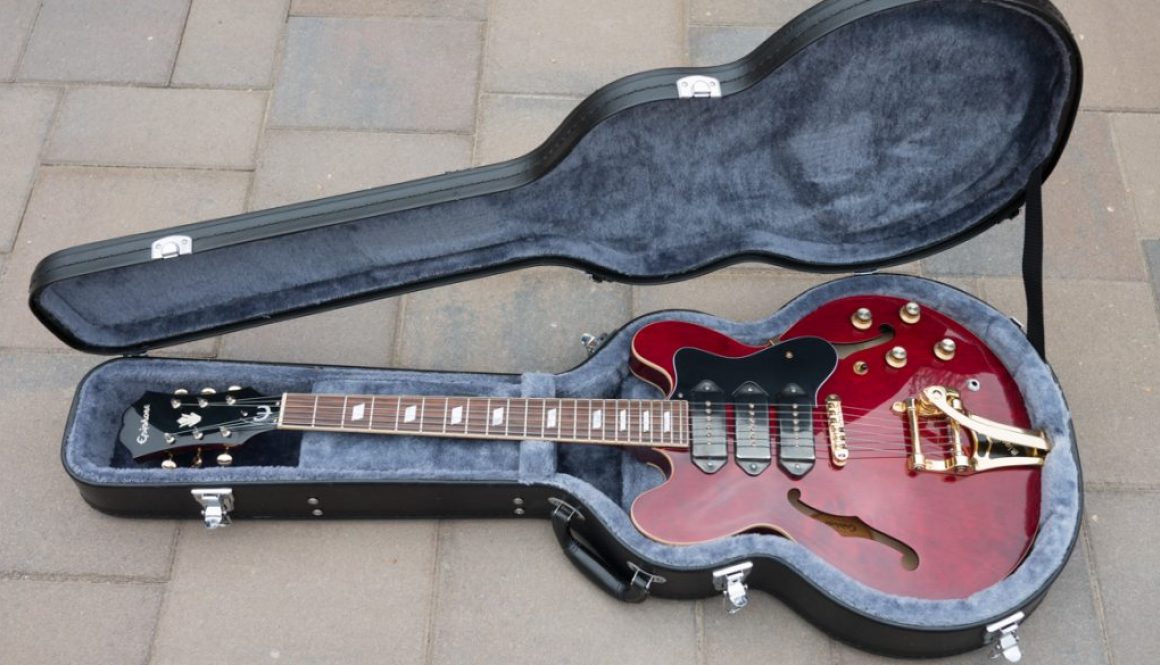
In this video, I apply this simple trick to the tuners on my Epiphone Riviera P93. Some of these screws have been loose since day one – the kind of loose where no matter how much you try to tighten the screw, it just spins freely in the hole. The wood fibers in the hole are stripped out and no longer gripping the screw threads. One simple toothpick, inserted in each hole and cut off flush, just like that carpenter had shown me- and now the screws go in nice and tight. The soft wood of the toothpick makes the perfect filler. No glue necessary.
That same carpenter also shared these fine words of wisdom: “Caulk and paint are what a painter ain’t”, but that’s a story for another day 

Tuesday, May 15th, 2012 at 8:57 am
Back in 2009, I described my frustration with the Tune-o-matic bridge on my Epiphone Riviera P93. The retainer wire that holds the saddle screws in place is just a terrible design. A good choice to address this issue is the Nashville style tune-o-matic which has individual saddle retainer clips, while also increasing saddle-adjustment range for intonation. Another good possibility is a roller bridge, like the Wilkinson B33. I figured the roller may pair well with the Bigsby, possibly improving the Bigsby vibrato’s general tuning instability.
In this video, I show how to swap in the Wilkinson bridge, and then do a series of comparisons to see if there’s any difference in the overall tone, sustain, and tuning stability with the two bridges.
I recorded many many takes of the strum-tests comparing tone and sustain, and my results were always pretty inconsistent. Despite my best efforts, it’s impossible to produce the exact same string excitation for each strum. So, I think the variances in sustain and tone are largely insignificant- though it does appear that, across all my tests, the roller may have slightly longer sustain times. I imagine that if I replace the Epiphone bridge posts with the beefier Wilkinson posts there may be a greater sustain improvement, but I’ll leave that for another day.
The tuner I use during the tuning stability section is the excellent Planet Waves Tru-Strobe (PW-CT-11) tuner.
Friday, February 4th, 2011 at 7:54 pm
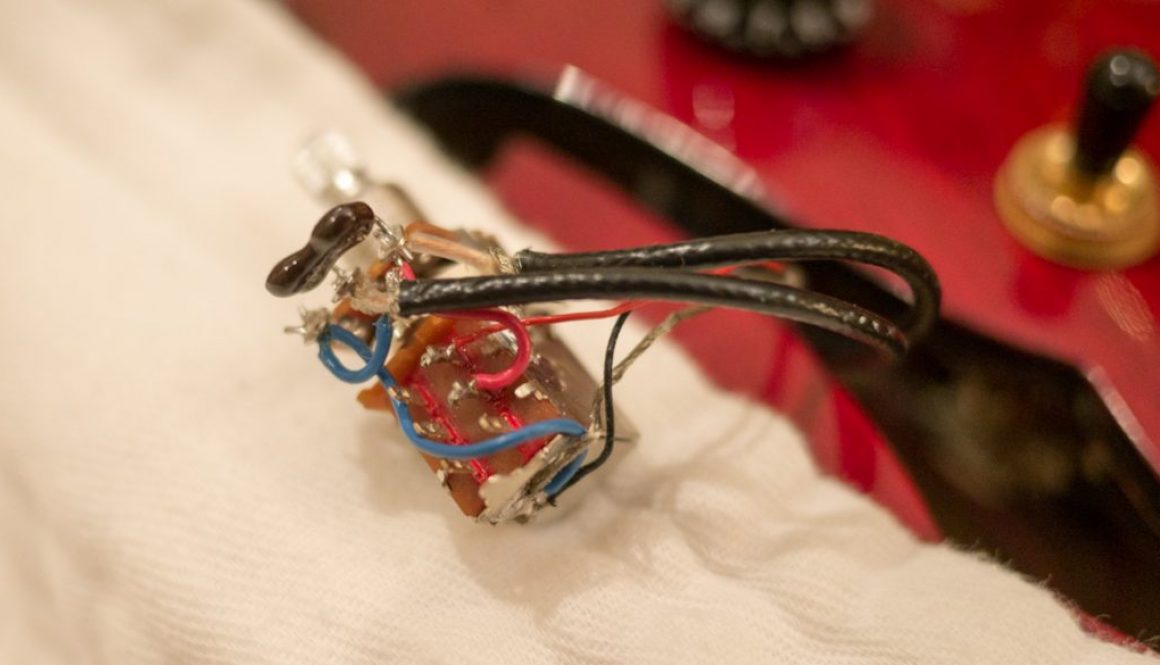
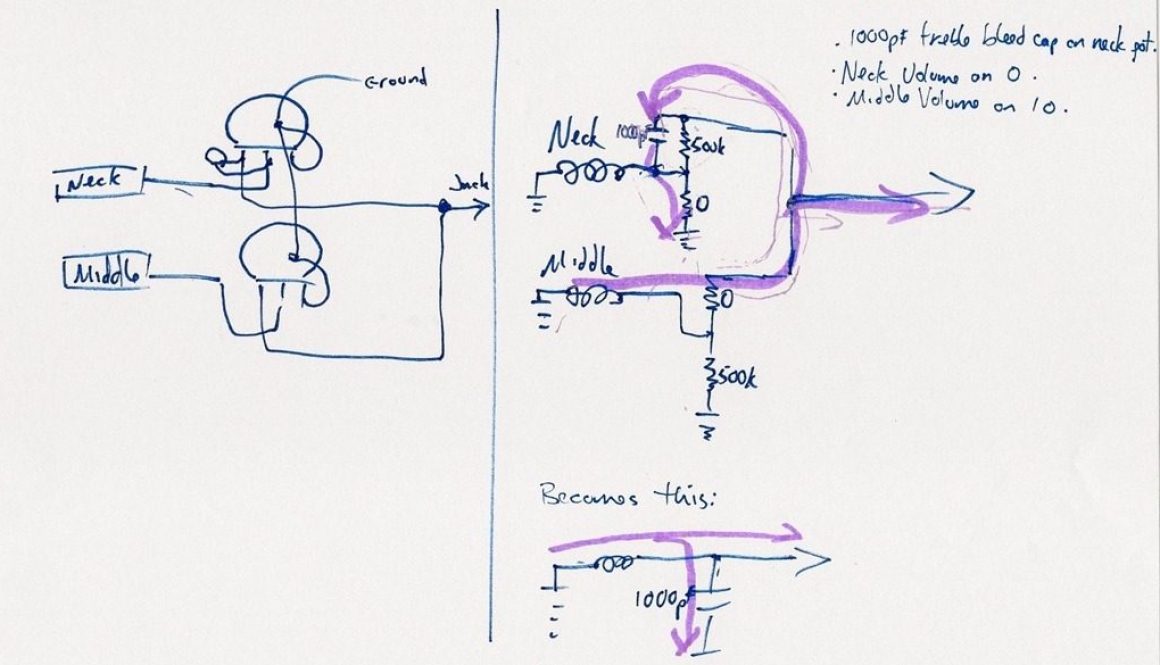
A while back, I described some problems with trying to use treble bleed on a guitar with multiple volume pots. When turning down one volume pot, that pickup retains brightness, but the other pickups get duller. In the diagram at right, with middle and neck pickups in a blended switch position, the middle volume is up full and the neck volume is turned down. The middle pickup high frequencies have a path to ground through the neck treble bleed cap.
This problem even exists on your typical two pickup, three way switch guitar (Les Pauls, ES-335’s, Sheratons, etc). But, with only two pickups, the switch has two non-blending positions which completely isolate a pickup. When one pick up is isolated, there is no issue with having a path to ground through the other volume control’s treble bleed cap. However, in the middle switch position, the two volume pots are tied together and you’ll hear the dullness problem if you turn down one of the volume knobs. In this case, it’s not so bad (and most people won’t notice) since you’re blending the sounds anyway.
But with three volume pots and a three way switch like my Epiphone Riviera P93, there is no way to isolate one pickup. The middle pickup is always on in all three switch positions, so there will always be bad interactions with the treble bleed. The stock Epiphone G-400 Custom exhibits this problem, with treble bleed caps on all three pickups.
I punted on a solution for my Epiphone Riviera P93, and just left it without treble bleed. However, I’m finding that the way I use this guitar would really benefit from some treble bleed.
Read the rest of this entry
Tuesday, May 18th, 2010 at 10:01 pm
Finally! Time to ditch the cardboard and reinstall the electronics into my Epiphone Riviera P93.
In this two-part video, I demonstrate the trick to getting it all back in though the f-hole. It ain’t easy, but trust me- you can do it. Just be prepared that it may take a few tries to get right. Expect to get everything half way in and then realize that something’s twisted or upside-down, requiring you to pull it all out and start over. It’s no big deal if you’re expecting it
And how sweet it is to have it all back together again.
Thursday, April 15th, 2010 at 8:10 pm
Here are the recordings lifted from my most recent Tone Cap Comparison Video, split into individual files. The files are named using generic numbers, rather than labeling them by cap type – so you can listen to these without being influenced by preconceived ideas of what a particular material type should sound like.
Download them all as a single 2Mb zip if you’d like to use a double-blind tool (like WinABX or foobar with ABX).
Or try this. Before checking the legend (linked below), listen to the examples and choose the one you like best. After you’ve decided what you like, only then check the legend which says what cap type is used for each recording.
Read the rest of this entry
Tuesday, April 13th, 2010 at 8:16 am
I’ve received a lot of questions and comments about my tone cap videos part 1 and part 2.
In this video (split into two parts due to YouTube length limits), I answer some of those questions, and record some more examples. I talk about 50’s versus modern wiring, my recording setup and how the audio is processed, and how to do double-blind testing. I measure the cap values, and record another set of examples, now including ceramic caps and distorted examples.
Wednesday, February 17th, 2010 at 12:01 am
Well, part 2 of the tone video took waaaay longer than I anticipated! I spent a ridiculous amount of time editing, and animating illustrations of the tone circuit.
Here I present a tutorial on how to read cap values, an explanation of how the capacitance and resistance work together as an RC filter in the tone circuit, and some audio examples to help in selecting a useful cap value for a tone circuit.
I play through a series of Orange Drop polypropylene caps with values (pictured right-to-left) .047uF, .022uF, .01uF, 6800pF, 4700pF, 3300pF and 1000pF.
I purchased these Orange Drops at Mouser – significantly cheaper than at guitar specialty stores.
As with part 1 of this video, everything is played on my Epiphone Riviera P93 with Vintage Vibe Guitars P-90 pickups, through my Vox VT30 on the Boutique Clean model, mic’d with a Rode NT1 large diaphragm microphone.
Thursday, February 4th, 2010 at 9:11 am
After much deliberation, experimentation, determination, and the inevitable procrastination and distraction… I’ve finally completed this comparison of tone capacitor material types and capacitance values. In part 1, I’ll evaluate a bunch of different dialectric material types to see how they change the character of the sound. In part 2, I’ll cover how different capacitance values affect the range and usefulness of the tone pot.

First, I built this Tone Thing
It’s a piece of cardboard on which I mounted 7 different capacitor material types, and 7 Orange Drops of different capacitance values, and one Bourns 500k audio taper pot. This is connected up with alligator clips to my Epiphone Riviera P93, in parallel with the signal at the output jack (the same place as the master tone in a regular guitar circuit).
Read the rest of this entry
Tuesday, December 29th, 2009 at 11:24 pm
In this video, I finally bring together the results of the last 20 or so videos, and demo the results of my Epiphone Riviera P93 electronics overhaul. I first demonstrate the original Epi setup, then swap in my new electronics, and then replace the pickups with a matched set of new Vintage Vibe Guitars P-90’s.
The new electronics include CTS 500k audio taper pots, no-load mod on the tone pot, an Orange Drop .01uF tone cap, all new shielded wire, and a new Switchraft L12A jack. So, if you’re wondering what it might sound like if you change out your pots and caps in your guitar, this should be a good example. (Note, I’m changing the jack for mechanical reasons, not to improve the sound).
The recordings are made with a Rode NT1 large diaphragm mic, placed 4 inches away from and slightly below center of the speaker grill of my Vox VT30 amp. Read the rest of this entry
Sunday, December 13th, 2009 at 12:20 pm
In part 3 of the video series on installing pickups, I select some screws and show some tricks for drilling the holes right where you want them.
For the screws, I chose some slotted silver 3/4” long #4 wood screws. Even though the Bigsby and tuners are finished in gold, I think these silver screws will look good with the polepieces.
Since the new holes will overlap a bit with the old filled holes, the drill bit will have a tendency to walk into the old hole. The bit always wants to take the path of least resistance. I’m using a Rockler Self-Centering Bit, which makes it really easy to drill precisely centered holes – it’s good for things like door hinges and cabinet hardware too. If you don’t have one of those, the next best thing is a brad point drill bit, which has a sharp spike to prevent the bit from shifting. With a brad point bit or regular bit, you’ll want to use something sharp like a drill punch or awl to give the drill bit a good starting point.