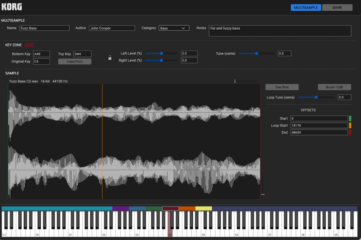
Fame Stems

File:Bowie Fame.jpgWriting last week’s article Here Comes The Solo really got me thinking about that old Fame remix and the Beatnik Editor again. 

In a fit of uncontrollable nostalgia, I went through some old files, and found a likely candidate amidst a pile of other detritus: fame.rmf

Now, all I needed was something to play it in.  The Beatnik Player Plugin, circa 2001, looks like it’ll work great in Netscape Communicator from the same epoch, but unlikely to work in Chrome 2012 (!!!)

So, I managed to scrounge up a barely-working copy of the Beatnik Editor, loaded it up, and was surprised to see that the file played and I could solo the various tracks.  It’s very low quality- the entire RMF is only 325Kb- but it’s all about the magnificent vibe!  I recorded a bit of the fun:

Click here to listen.

Sweet ES-355

When I purchased my Riviera P93, what I really wanted was a semi-hollowbody in the traditional Gibson ES shape, with a Bigsby tailpiece.   I didn’t want to invest the extra several thousand dollars in a Gibson, and the only model available from Epiphone was the Riviera P93.

I took a chance on the P93, and as you may have seen in my blog, it turned into quite a project trying to improve its sound.  In the end, even after replacing the pickups and electronics, I am ultimately frustrated by the three pickup, three volume, one tone configuration.  I would have preferred the traditional two humbuckers, two volume, two tone configuration.

I still haven’t completed my planned changes to improve the usability of the middle pickup, nor have I replaced the buzzy bridge with the roller.  Changing these three pickups to two humbuckers is certainly possible, but the result would be less than beautiful due to the different hole-spacing and routing requirements of dog-eared P-90’s versus humbuckers.

A couple months back, Epiphone announced the guitar which I wish had been available when I purchased the Riviera P93: the new Epiphone ES-355

Read the rest of this entry

Here Comes the Solo

BeatnikMobilePlayer

There’s nothing quite like the experience of hearing the individual source tracks from a song you’ve known and loved all your life.  

My first such experience was around the year 2000, while working at Thomas Dolby’s company Beatnik.  I developed the mobile Beatnik Player (shown at right) and the Beatnik Editor which was used to produce a web-remix version of David Bowie’s Fame. This was waaay before the days of Rock Band and downloadable “stems” of Radiohead songs.  It was mind-blowing to be able to solo the individual guitar riffs and drum tracks, and hear Bowie’s and Lennon’s voices isolated.

Update: Feb 10, 2012, I dug up the old Beatnik Fame RMF file and posted a recording of it here.

When iconic songs are so deeply internalized from a lifetime of listening- as is the case for me with most of the Beatles’ catalog- it’s almost surreal to hear the individual tracks. When listening to Beatles recordings in stereo, I often can’t resist adjusting the balance all the way to the left or right, to isolate the drums and guitars away from the voices, etc. You can get a bigger taste of this with Beatles Rock Band, if you have the patience to play a plastic guitar.

Recently my daughter Emily has fallen in love with Here Comes The Sun.  I think they had her at “little darling”, but it’s easy to see how a six year old can be swept away by such an unabashedly optimistic and joyful song.   This morning, I happened to come across this video, in which Beatles producer George Martin and his son Giles, as well as George Harrison’s son Dhani, are listening to the source tracks from this wonderful song, and unexpectedly discover a take of George’s guitar that never made it into the final mix.  The look of on Dhani’s face is exactly what I’m talking about.  Magic.  Take a look:

Double-Blind Audio Brains

Spinning_DancerI was reading the news on Zite this morning, and serendip’d upon this article in The Strad which describes a double-blind test with violinists, comparing several modern violins to those made by Stradivari and a del Gesu.  The scandalously shocking surprise was that many accomplished players unknowingly preferred the modern instruments over the high-value vintage rarities.

Now, I’m not a violin player, but I can appreciate a story about challenging the preconceptions of value in hyper-expensive vintage items over well-crafted lower-priced contemporaries.  It’s not so much that they were pitting the modern luthiers against the celebrated ancients;  these were doubtless all well crafted instruments.  The experiment was really challenging the human perception and preconceptions of the study participants.

650px-Mond-vergleich.svgIt’s an interesting philosophical/psychological question whether it’s even possible for the human brain to be objective about anything.  There is a disconnect between perception and reality—our brain is an imperfect interface to the world around us, doing its best to interpret the signals it receives, and occasionally totally falling down on the job.

I’m sure you’ve seen these great mind-bending optical illusions, like the spinning dancer above (which way is she really spinning?  I see her spinning counter-clockwise, but my wife and kids see her spinning clockwise), or the Ebbinghaus Illusion at left (yes, the orange balls are actually the same size).

But have you heard any good auditory illusions lately?  Try these:

Read the rest of this entry

A POD in your Pad

Line6 Mobile InThe new Mobile In iOS guitar interface and Mobile POD app from Line 6 claims to put the POD sound library in your iPhone or iPad.

This interface connects to the 30-pin dock, which as I described in my DIY iOS interface project, is the higher-fidelity lower-noise way to get audio into your iPhone/iPad.  This is because there is a high-quality 24-bit 48kHz D/A in the interface itself, and the signal is transferred digitally into the iDevice.

Again, my main concern with this type of device is that it hangs off the bottom of your iPhone/iPad on that delicate dock connector, with the guitar cable plugged into that.   It makes me nervous that the inevitable kick-the-cord accident will brick your $600 iPad.  Also, the iPhone/iPad can’t charge while this is plugged in, so you have to make sure you’re fully charged up.

At $79.99, this is cheaper than the other digital guitar interfaces (Apogee Jam, Sonoma GuitarJack, etc).   The iOS app is free, but is tied to the hardware.  You currently can’t use the app with another interface.

Intriguing, but I’m not rushing out immediately to get one.  Are you?

Digitech JamMan Delay EMI problem and solution

JamMan DelayI wrote about my love of looping back in 2010, when the new JamMan Solo and JamMan Stereo were announced. 

Now, I’ve finally replaced my old Oberheim Echoplex Digital Pro with a shiny new JamMan Delay.

This unique pedal combines a looper with a nice delay modeler.   It doesn’t do everything my old Echoplex did, but it’s a nice leap forward in technology- with stereo recording, tons of memory (and SD card expansion), stereo recording, USB connectivity and software librarian, not to mention some really nice delays.  I’ll talk about the features I’m missing in another post.

But before we get to happiness, let’s first talk about a major manufacturing issue, nearly a total deal-breaker.   If I hadn’t figured out a solution, I would have had to return the JamMan Delay and seek looper nirvana elsewhere.

When I first powered up the JamMan Delay and plugged it in to my Vox AC15, I was greeted with a faint but persistent “beep beep beep” sound, in time with the flashing tempo LED.  

Read the rest of this entry

George Harrison’s Vox UL730

George Harrison's Vox UL730

It’s an interesting tale of intrigue, the discovery that this old dusty Vox UL730 belonged to George Harrison.  It was used during the recording of Revolver and Sgt. Peppers.

You want that sound?  Buy this amp at auction!  It’ll only cost you about $100,000.

Update 1/4/2012: I went back to see how much the amp sold for, and it turns out the auction was withdrawn- the mystery owner decided to keep it.

Read more about this amp at the vox showroom.

 Beatles In Studio with Vox UL730


… November 29. Rest in peace, George, 10 years now gone …

Assembling the iDevice Guitar Interface

Update: 10/19/2011, added links to part #s at radioshack, mouser and mammoth.

Here’s the exciting conclusion to the series, following up the intro in Part 1, and the electronics course in Part 2.  

The main goal here is to cram all the parts into the narrow confines of the jack, so we don’t need to use an external box or enclosure. 

In addition to the cable and jack parts listed in Part 1, here are some of the things you’ll need:

Read the rest of this entry

Simple JFET Preamp for an iDevice Guitar Interface

iPad Guitar Interface SchematicFollowing up on Part 1, it’s time now to get into the heart of the project:

In this video, I talk about how JFET’s work, then work up a circuit diagram (as shown at right).

Then, I prototype the circuit on the breadboard of my Radioshack Electronics Learning Lab, and finally play through the circuit to show how it sounds.


In Part 3, I’ll demonstrate how to assemble the circuit so that it fits entirely inside the jack.

Here are some useful resources and background reading:

Read the rest of this entry

Building an iDevice Guitar Interface Cable

Amplitube on the iPad 2A few months back, I purchased the ultimate unnecessary-but-awesome gadget: the iPad 2.

With the availability of apps like Amplitube, AmpKit, and Garage Band, it’s immediately obvious how this device can be an amazing guitar learning and practicing tool.  I’ll talk more about that in another article.   But before you can plug in your guitar, you need a special interface…

In part 1 of this 3-part video series, I introduce the project- how to make your own impedance matching, buffered guitar interface for the Apple iPad, iPod touch and iPhone.   These iDevices all share a similar headphone/microphone jack specification, so this circuit should work with all of them.

I’ll show you why a simple unbuffered cable interconnect will sound terrible- because of the significant impedance mismatch between a passive guitar circuit and the iDevice mic jack.  Also, the iDevice provides a 2.8V DC on the mic input to drive a microphone preamp, and as you’ll hear, this voltage totally screws up your guitar circuit.

This isn’t intended to be an ultra-high-fidelity interface. But trust me, it sounds good and costs very little. And the principals learned in this simple electronics project are the same as those required to make a guitar boost pedal like the Fulltone Fatboost.

In parts 2 and 3, I’ll explain all the electronics and show you how to assemble the interface, but for now, let’s get started:

And here’s some of the things you’ll need:

Read the rest of this entry

 Page 4 of 15  « First  ... « 2  3  4  5  6 » ...  Last »