
Ideas for Treble Bleed Problems
Update: I describe my final mods in this post.
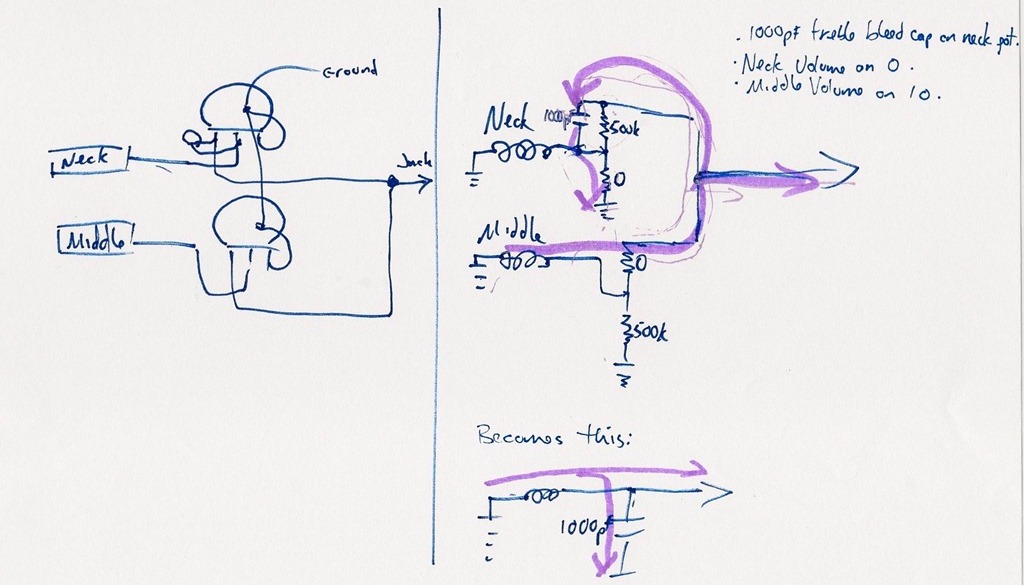
A while back, I described some problems with trying to use treble bleed on this guitar with three volume pots and a 3-way switch. When turning down one volume pot, that pickup retains brightness, but the other pickups get duller. In this diagram, with middle and neck pickups in a blended switch position, the middle volume is up full and the neck volume is turned down. The middle pickup high frequencies have a path to ground through the neck treble bleed cap.
This problem can be avoided on a typical two pickup 3-way switch guitar (Les Paul, ES-335, Sheraton, etc) because on those, with only two pickups, the 3-way switch has two non-blending positions which completely isolate a pickup. So instead of using the independent-volume (decoupled) wiring (pickup signal wired to center volume pot lug), you can use non-independent-volume (coupled) wiring (pickup signal wiring to side pot lug). In that configuration, there is no treble loss when turning down the volume, but if you turn down the volume all the way, it also kills the volume for the other pickup. (Hence the “non-independent” in the name). But this isn’t a problem because with only two pickups, if you want to turn off one of the pickups, you can just use the 3-way switch – you’ll never need to turn a volume pot all the way down.
But with three volume pots and a three way switch like my Epiphone Riviera P93, there is no way to isolate one pickup. The middle pickup is always on in all three switch positions, so there will always be bad interactions with the treble bleed. The stock Epiphone G-400 Custom exhibits this problem, with treble bleed caps on all three pickups.
I punted on a solution for my Epiphone Riviera P93, and just left it without treble bleed. However, I’m finding that the way I use this guitar would really benefit from some treble bleed.
So, here are some possibilities to consider:
- Update Feb 9, 2011: Another option occurred to me. This is a variation on #1,2 and 7 below. Replace the middle volume pot with a push/pull pot. Make this a master volume control with treble bleed, and make the push/pull enable/disable the middle pickup. Additionally, move this pot to be the closest to the player position. I’m liking this idea a lot, and may give it a try.
- Update 10/24/2017: That idea worked out well! I finally wrote up the new circuit here.
- Put treble bleed capacitors on just the neck and bridge volume pots. The bleed caps will work well in the up and down switch positions, if the middle pickup is turned down. In the middle switch position, there’d be the same interaction problem between neck and bridge, just as with any two-pickup guitar.
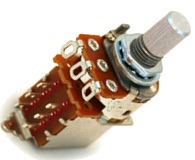 Same as the previous idea but additionally put a push/pull pot on the middle volume to turn off the middle pickup. This makes it easier to isolate the neck or bridge, without having to turn down the middle volume knob. But with middle pickup on, or in the middle switch position, you’ll still hear the problem.
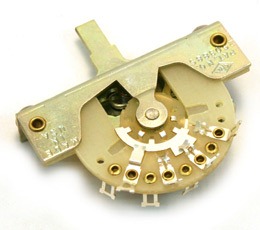 Replace the three way switch with a five way switch, wired like a Strat. This provides three switch positions which completely isolate a pickup. In positions two and four, the middle pickup is blended with a neck and bridge. There’s no way to play with all three pickups simultaneously, nor bridge+neck. Requires drilling two new holes and routing a slot.
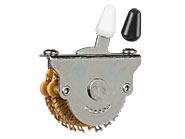 Replace the three way switch with a five way four pole super switch. This switch is pretty amazing, allowing you to enable the treble bleed caps only in the non-blended positions. E.g. Neck with treble bleed, neck + middle no treble bleed, middle with treble bleed, middle + bridge no treble bleed, and bridge with treble bleed. Unfortunately, it requires a two new holes and a slot to be routed. Fairly pricey too.
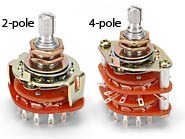 Same as the previous idea but make it a 5 or 6 position four pole rotary switch. The 6th position would allow all three pickups together or neck+bridge. Doesn’t require slot-routing or drilling. Cool, but a rotary switch is a bit more fiddly to adjust when playing live.
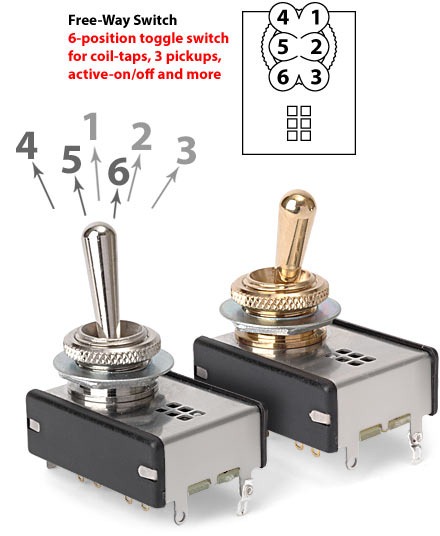
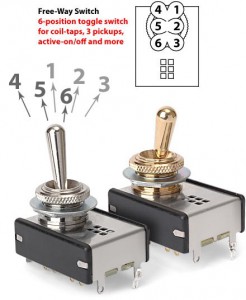 Replace the three-way switch with a Free-Way 6-position switch. Doesn’t require slot-routing or drilling. Provides fast switching. Allows pickup isolation for all three pickups, as well as the same blended choices as the 6-way rotary. Doesn’t allow the treble-bleed to be selectively enabled for the non-blended positions. Quite pricey.
- Add a master volume knob with treble bleed. This would require drilling another hole in the guitar, and I think five knobs is just too many.
- Instead of three volume pots and one tone, have three tone pots and one master volume, and a 5 or 6 way switch. Hey, it’s a 4 knob Strat!
- Replace all three volume pots with push/pull pots, pull to individually disengage treble bleed. Too tweaky to use!
- Replace the three volume pots with volume controls which open-circuit when turned down to a 0 detent. Do these even exist?
- Something else I missed?
A number of people suggested trying to use diodes to make a one-way valve for the signal, but this won’t work. A guitar’s audio signal is alternating current (A/C), so a diode would act as a half-wave rectifier, clipping the signal and resulting in distortion. In fact, you can make a simple passive distortion circuit by using a pair of diodes to symmetrically clip the signal. That’s just how the little Black Ice device works.
So many choices, hmmm. I’m leaning towards #2 (bleed only on neck/bridge, with push/pull on middle), #6 (free-way switch), or possibly #5 (rotary 4-pole). Update Feb 9, 2011: see the first item on the list for my new preferred idea.
June 28, 2011 @ 11:16 pm
Hi John – I love your site, and your videos were a great resource for me when I started modding my guitars.
Option #1 sounds like a good way to go, though I wondered if you’ve considered a blend pot for two of the pickups (maybe bridge & middle)? It would alter the tonal function of your controls some, but maybe you would loose fewer highs since you’d effectively gain them from one pickup as you turned down the other? You’d be able to keep a treble bleed on the independent volume pot. I think it could introduce some interesting tonal options as well.
It could also free up a slot since you’d basically be combining two volume knobs into one, so you could add something like a bass contour/G&L style PTB circuit (I recently tried this out on my main guitar and I love it – it allows you to roll off a little bass to keep things from getting too muddy).
July 1, 2011 @ 6:40 pm
Have you tried simply disconnecting the earth from the end of pot?
The earth connection is not strictly required and merely sends the pickup output to ground.
This means that the pickups are better decoupled and the path to ground simply disappears. I’m trying this on my new wiring scheme (not finished yet, but will examine this when it’s done) http://www.matsumoku.org/ggboard/viewtopic.php?f=13&t=7613
Much better than adding switches.
I love your work!
Regards,
Tony C.
July 1, 2011 @ 9:38 pm
Hi Tony,
I’m not sure I’m following you. One side lug of each volume pot must be wired to ground in order to make a proper voltage divider for the volume control. Please let me know if I’m misunderstanding you!
Beautiful guitar you have there!
-John
A Bloody Mess - Planet Z
July 1, 2011 @ 9:33 pm
[…] Update Feb 4, 2011: I wrote up a number of ideas for solutions in this blog post. […]
July 2, 2011 @ 12:10 am
You can just use the pot as a variable resistor in series with the pickup. This still limits the signal but allows de-coupling of the pickups. Connecting the pickup output to ground via the pot serves no purpose.
See the diagram of the neck volume control from the design I’m trying (at the linked page).
This isn’t my design, and it’s still being built, but I have no reason to doubt it will work.
Easy to try – just disconnect the ground.
Also, I’m trying a resistor in series with the capacitor on the individual volume controls (al la Kinman) and in parallel on the master volume.
Regards,
Tony C.
July 2, 2011 @ 8:50 am
Interesting suggestion. However, it won’t quite work like a normal volume pot. Without the voltage divider, it won’t be able to turn the volume down to silence. At 0 resistance, you’ll hear the full signal, and at full resistance you’ll be reducing the signal current but not silencing it. Even with a 1meg pot, you’ll still hear plenty of signal getting through. Unless I’m missing something. I just tried through a couple pots to confirm. Let me know how it goes for you! (And as I always say, make sure you test with alligator leads before soldering it all together!)
John
August 31, 2011 @ 9:51 am
To me guitars are like girlfriends; they come and go.
However, the attractive new acquaintance you’ve been flirting with sure seemed like the girl of your dreams but after a while the luster wears off and she’s quick to point out your faults. When the relationship goes a little south, she tells you, “It’s me, not you,” and she needs to go.
So you tell her that you’ll change. “I’ll be a better player. What can I do to make you stay?!” you cry.
She hums a little, and tells you that she needs some attention. “I can do that for you honey!” you tell her. “What else do you need?”
And it goes from there. Before you know it, you’re installing new tuners and bridges, compensated nuts, CTS pots with treble bleeds and Lindy Fralins. You and her are making plans for the future.
It just goes to show you, there’s often more work in maintaining the relationship than the initial investment.
I recently purchased an Epiphone Riviera P93. And like thinking exactly as John, my new baby needs some new bling. She’s got all the great looks of Eliza Doolittle in My Fair Lady, but needs some character refinement.
After a quick set-up, I started Eliza’s transformation by replacing the tuners with a set of nice Kluson vintage style square-backs. The pearloid keys make for a nice upgrade. I have a Gibson bridge on order but may consider a Schaller roller bridge – but not 100% convinced its necessary.
Unfortunately Eliza still has her cockney accent (via Beijing) and have my eye on a set of Lindy’s. CTS 500K audio taper vol pots are definitely on the plan as are PIO Russian caps. I like the idea of a push/pull for the middle pup. I also like the idea of doing something like the no load tone pot but need to do more research on this.
Bottom line, she started off as a good looking girl and with a little refinement, has the potential to be a real fine lady.
Now I just need to keep my other girlfriends from getting jealous.
August 31, 2011 @ 9:59 am
Haha! Your story put a smile on my face.
The bridge replacement and middle push/pull are still on my list. I’ve been distracted with other mistresses…
BTW, that’s a Qingdao accent, not Beijing 😛
-John
Sweet ES-355 - Planet Z
February 10, 2012 @ 5:27 pm
[…] configuration. I would have preferred two humbuckers. I still haven’t completed my planned changes to improve the usability of the middle pickup, nor have I replaced the buzzy bridge with the […]
April 25, 2012 @ 11:01 pm
Just got a P93 and was looking online for a wiring diagram and came across this thread. I have never liked the Gibson/Epi 4 pot 3-way switch deal: all my guitars get rewired with a Master Volume w/a 500pf bleed cap. Just my personal preference. So, if I decide to keep my “Limited Edition Riviera Custom Royale P93 Electric Guitar” I will remove the 3 way and install the Master Volume in it’s place. And I will install, either in the pickguard or on a small metal plate extending from the PG, 3 micro switches which will switch each pup on/off.
Of course by this time you may not even have a P93… LOL!
All the best,
Murali
April 26, 2012 @ 12:28 pm
I like having a master volume too. What will you do with the other four knobs?
-John
April 26, 2012 @ 12:54 pm
Hi John,
I’ll leave ’em in place. Might be nice to be able to control the individual pup volumes and who knows? I may someday want to vary the tone a little. LOL!
Of course you KNOW what a pain it is to work on any hollow body with no control cavity access. I’ve only had the thing here 2 days and I already need to tighten the nut on the output jack. And Epiphone, in their wisdom, did not use a lock washer so I’ll have to contrive, or look up online, a method for tightening the nut without the jack spinning ’round and breaking the wires off.
Despite the size of the body and ridiculous 9lb weight, I do think I’ll keep it. Great tones even with the ultra-cheap Epi P90s.
Cheers,
Murali
April 26, 2012 @ 1:02 pm
Yes, the jack is a pain. This is one of my earliest youtube videos: https://www.planetz.com/?p=176
I used a 1/4″ inner-tooth lock washer, and the jack hasn’t budged since.
-John
April 26, 2012 @ 3:24 pm
Thanks for the tip. Now here’s one you may not have used:
Use a rat-tail file inserted into the jack with just enough pressure against the side of the jack to immobilize it and a 12mm or adjustable crescent wrench to tighten the nut.
I did this only to find the nut is cross-threaded, so will not tighten but eventually strip the threads. Looks like this P93 is going back to Musician’s Friend after all. : (
Cheers,
Murali
April 26, 2012 @ 3:34 pm
Sorry to hear that! Sounds like you liked the guitar!
For jack tightening, I’d worry a bit with the file that you’d be marking up the inside of the jack, which wouldn’t be good for the life of your cable plugs.
I used a pair of needle-nose pliers to hold the jack in place while tightening, like you see in my video on reinstalling the electronics in a semihollowbody:
http://www.youtube.com/watch?v=YNYBnAqYDwk&t=5m22s
There’s also some custom tools for jacks, like the JackTight, but I’ve found this pliers technique to be sufficient.
-John
April 26, 2012 @ 4:03 pm
Hi John.
I did watch the vids. Yes, that looks like it will work, too.
I’m on the fence w/the P93. Sadly, it’s just so HEAVY. I gig 2, 3, sometimes 4 nights a week, 3 – 4 sets a night. The P93 would be good for about 1 set. LOL! I’m also interested in the Wildkat: smaller body = lighter I hope. And if I like it, I can drop in a 3rd P90. Have you played one?
Best,
Murali
April 26, 2012 @ 4:30 pm
Hi,
Yes, I have played the wildkat. The electronics are pretty nice- more like what you want. There’s a master volume and tone, and two individual volume knobs. 3-way switch in the usual les-paul position. I think the volume controls were wired like a typical gibson 2-pickup (not independent volume, so it stays bright even when turning down individual volumes, but turning one down all the way also turns the other off).
Smaller body, should be lighter.
I don’t find the P93’s weight troublesome, even for several hours- but I’m not playing every night for that length. You want heavy- check out a Les Paul Standard. Ouch!! 🙂
-John
July 22, 2012 @ 7:06 am
Hi John,
would not a serial (with the capacitor) 150k resistor do the trick?
Someone suggested it earlier, but it seems you have not replied to that suggestion.
The resistor would make the sound nicer too!
Vaze
July 25, 2012 @ 5:51 pm
Hi Vaze,
Adding a resistor in series with the cap reduces the amount of treble bleed, which is useful if the guitar gets too bright when turning down.
So yes, it would also prevent some of the treble loss through that signal path when one pickup is down and the other isn’t. It’s a complicated equation, hard to visualize without trying it (which I will do next time the guitar is apart). It’s worth the experiment, but I don’t think it’s a total solution.
Thanks,
John
April 19, 2014 @ 4:53 pm
Hey what values would you suggest for 2 volumes, no tone. I recently modded my Blacktop JM with 2 volumes, and get some cool sounds in the middle position. I would like for them not to get muffled turning down in the middle. My friend suggest 680pF/200k, but would putting these values on both pots work?
Also, what about putting a treble bleed on just one pot?
April 22, 2014 @ 9:54 pm
Those would work individually, but you’ll get some funny interactions with the switch in the middle position, as I described in this post/video: https://www.planetz.com/a-bloody-mess/
Experiment with alligator leads to see what results you get.
-John
November 23, 2014 @ 3:33 pm
Use a small op-amp circuit – an amplifying active low pass filter to be exact. One potentiometer can adjust the corner frequency of the low pass filter, and the other potentiometer can adjust the feedback gain. By using one tiny amplifier for each pickup, you can isolate the different parts of the circuit from each other, and then at the end, mix the amplifiers’ outputs together using one more op-amp as an active mixer (if you want you can put a potentiometer on this for master volume control.)
You can find plenty of op-amp chips that actually contain multiple op-amps inside a single chip.
November 23, 2014 @ 3:44 pm
This issue applies to passive guitar circuits, and I was looking for simple passive solutions.
Certainly, switching to an active circuit would solve all the treble loss issues, and provide the kind of extra flexibility you describe.
Thanks,
-John
December 25, 2014 @ 12:09 am
I think there is a simple solution for this problem. Use for volume pots a couple of stereo pots. It is really simple, when you turn down the volume, the treblebleed cap is dialed in. When you turn up the volume, then the cap is dialed out. The cap and pot is placed right after the pickup coil and before the volume pot. I did not try it because I don’t have the same guitar, but in theory this schematic should work. When you give me your Email adress I can sent you the schematic, because I can not post that here.
Kind regards Frans van Helvoort
February 16, 2015 @ 10:39 am
Hi,John! Great idea but first picture is not ordinary Les Paul wiring! Pickup signal goes to first leg of the pot!
February 16, 2015 @ 8:19 pm
Yes, that drawing is for the Epiphone P93, or any guitar with 3 pickups and 3 volume controls.
I need to update this post to clarify the differences between independent volume wiring (as discussed here), and non-independent wiring, as on a typical Les Paul.
-John
February 17, 2015 @ 4:03 am
I can share with guitar tonestack model in MicroCap
February 17, 2015 @ 8:11 am
I removed your previous comment. Please don’t post links to pirated software here.
Thanks.
-John
February 19, 2015 @ 7:52 am
Hi !
I like the 8 (3 tone + 1 master volume).
Do you think this solution should work :
https://www.flickr.com/photos/98180642@N02/15958812494/
I will try to model it with electronic part first
August 6, 2016 @ 3:02 am
Hi John,
i am no specialist in electronics, but thinking about the problem with treble bleed circuit in a Epiphone Riviera following came into my mind:
What if you put a Diode into the signal path between the volume poti and switch? Doing so this should prevent a signal reflow coming from another pickup. Am i right?
August 7, 2016 @ 8:07 am
As stated in the post: “A number of people suggested trying to use diodes to make a one-way valve for the signal, but this won’t work. A guitar’s audio signal is alternating current (A/C), so a diode would act as a half-wave rectifier, clipping the signal and resulting in distortion.”
Riviera P-93 Middle Pickup Mods – Planet Z
October 24, 2017 @ 2:19 pm
[…] written before about the circuit challenges on the Epiphone Riviera P-93 – treble loss when turning down […]
April 12, 2018 @ 7:15 am
Forgive me if this is an ignorant question, but is it the introduction of the treble bleed that creates this dilemma? If one were to leave this guitar in stock configuration, would there be concern for losing treble on the other pickups when you turn the middle pickup down (for example)?
April 12, 2018 @ 11:18 am
The treble bleed cap caused this dilemma. However, the reason I was considering treble bleed in the first place was that the stock wiring with independent volume controls leads to significant treble loss when turning down volume, due to increasing load on the pickups.
-John
April 12, 2018 @ 12:15 pm
So, if I’m understanding correctly – without the treble bleed turning down one pickup has no effect on the treble loss of any other pickup, BUT any volume decrease on any given pickup will result in significant treble loss on that same pickup. Is that right?
April 12, 2018 @ 12:38 pm
Yes, I think so.
April 12, 2018 @ 12:42 pm
Interesting. Thank you for putting all this out there to help others. Are you happy with the the push/pull master volume configuration you ended up going with?
April 12, 2018 @ 2:37 pm
I definitely find it to be an improvement over the stock wiring. Ultimately however, I just don’t use this guitar much. I find the 3 pickup 4 knob configuration to be overkill. I prefer a simpler setup with 2 noiseless pickups.