
What the Bleedin’ Treble!
In part one of this, video I explain what treble bleed is, and how to evaluate and select the right cap. I demonstrate my G&L ASAT III which has a treble bleed cap on the master volume, and I compare that with my Epiphone Riviera P93 which has no treble bleed caps (yet).
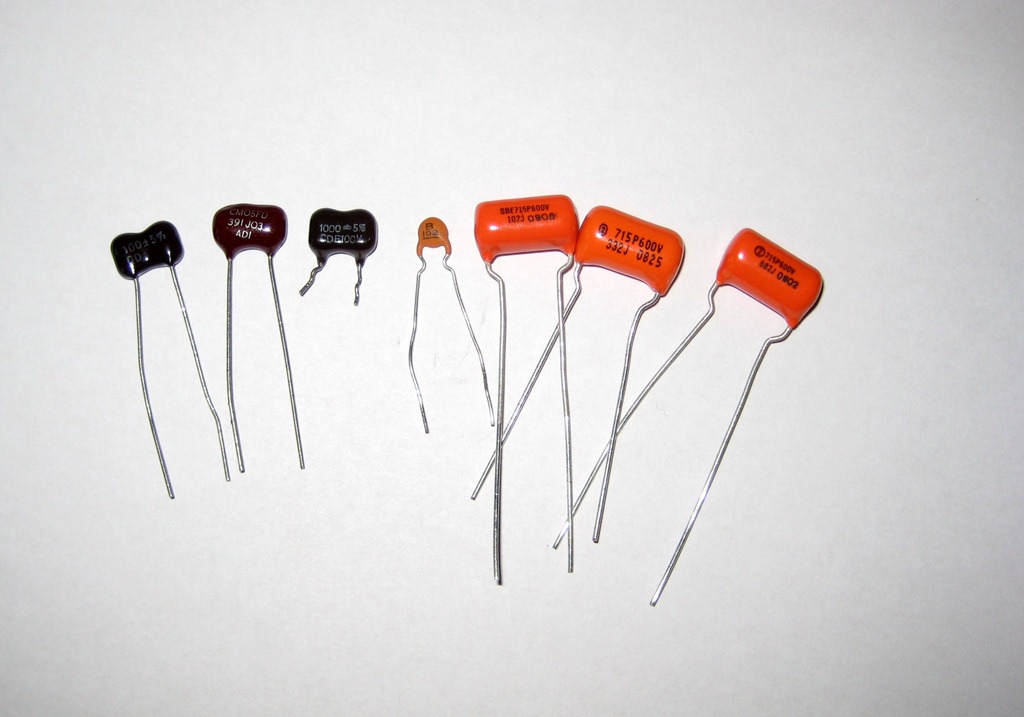
The caps I tried are (as shown left to right): Silver Mica 100pf, 390pf and 1000pf, a tiny 1000pf ceramic cap, and Sprague Orange Drop (polypropylene) 1000pf, 3300pf, and 6800pf.
The tolerances on the caps are a bit all over the place. I measured the 1000pf caps on my DMM and all were closer to 1250. The 100pf silver mica was over 250! This is assuming I can trust my Mastech DMM.
Higher capacitance here lowers the cutoff frequency of the filter, allowing lower frequencies to pass through. So you can hear more mids in the audio as I increase the capacitor value. Comparing the 1000pf ceramic, silver mica and Orange Drop, I really don’t hear much difference. I’m inclined to use the Orange Drop anyway for long term reliability, and because I have a few of them here.

The G&L’s treble bleed (shown here) uses a ceramic capacitor of only 200pf, allowing just the highest frequencies to pass. It’s a solid body guitar with very bright ceramic-magnet pickups. When the volume knob is turned down, it really cleans up well, and is extremely bright.
While the 1000pf cap really improves the brightness of the Epi bridge pickup at low volume, it’s still pretty boomy and distorted. I guess that these pickups have a hotter low-end than the G&L. In other words, I need to turn down the gain on the amp to get it to really clean up at lower volumes.
Update: I realized that the G&L volume pot is wired differently from the P93- with the pickup signal connected to the side lug and output at center lug, which provides a constant load-to-ground throughout the pot range, maintaining brightness.
The P93 is wired for 3 independent volume knobs, with the signal at the center lug and the output at the side. This means there’s na increasing load on the pickup when turning down, which results in a very dull sound. Also, it turns out that the P93’s volume knobs are much more linear than the G&L, so the Epiphone seems louder with volume on 1.
I’ve now realized that treble bleed caps simply won’t work well on a 3-pickup 3-volume pot guitar.
I didn’t try the resistor in parallel with the cap on the Epi, since there was already more than enough low frequencies getting through at low volumes. I did try adding a 100k and 300k resistor in parallel with the G&L’s 200pf cap, and these dramatically changed the sound, increasing the lows and mids passed through at low volume. The result was also more volume, and more distortion, so I ended up leaving out the resistors.
In the next post, I’ll show how to install a treble bleed cap.
For some more background info, take a look at Alan Ratcliffe’s article on treble bleed.
October 1, 2009 @ 12:57 am
I’m really interested in this project of yours, and also in the Riviera and I’m probably going to buy it as soon as I can. And I’m thinking of doing the same mods you’ve done so far and I’ll keep checking this project to get some new mod ideas!
Wish you the best, and thank you for this addictive (at least for me, I know, I’m weird) and instructive project of yours that I’m following as I follow some TV series.
Vin
October 1, 2009 @ 8:24 pm
Thanks Vin! Let us know when you get the Riviera, and how it goes for you!
-John
October 1, 2009 @ 6:56 pm
I’ve had my eye on the Riviera as a cool project guitar. (I already know that I would gut the electronics and wind up a set of p-90s.) How is the quality in which the guitar is made? Hows the hardware such as tuners, and the bigsby? (I’ll probally have to replace the tune-a-matic with a roller bridge.)
Thanks
October 1, 2009 @ 8:31 pm
Hey Mark- you’re definitely thinking the same as me!
The fundamentals are all good. The body is nice quality, finish is good, neck is fine and easily adjustable (truss rod works great), bigsby works great, grover tuners are good.
As long as you like the feel of the guitar – the size and weight of the body, and the scale, shape and radius of the neck, then you should be able to tweak the rest to your satisfaction. Note, it’ll also definitely need a good setup, some nut filing and fret dressing.
Winding your own pickups should be awesome! I’d love to hear more about that when you do it. I ordered a set from Vintage Vibe Guitars, and will be posting all about that soon.
I also purchased a roller bridge and will be posting about that after the pickups!
My recommendation- buy it while it’s still cheap, and have fun tweaking it into an awesome guitar. And keep in touch here about how it goes for you!
-John
December 8, 2009 @ 1:36 am
John, it was interesting how you compared the different types of capacitors (mica, PIO, OD etc) with your alligator clip setup to see what difference the capacitor construction might make (as well as what difference capacitance value might make).
One question: A somewhat similar and very popular “mod” out there seems to be using PIO capacitors on the tone pot to bleed off treble on pickups that are too ‘hot’ or ‘edgy’. I currently have this problem and was investigating whether changing the tone-pot capacitor would make any difference, whether it would ‘warm up’ my pickup’s sound by bleeding off the edgy treble. There is a huge ongoing debate in the forums out there as to whether the capacitor type makes any difference in that mod (as opposed to just increasing the capacitance value). There are a lot of people who swear that, for instance, PIO’s can bleed off excess treble and ‘smooth out’ the pick up’s sound much better than ceramic capacitors or other construction types. (This has let to all kinds of people immediately ripping their new Les Pauls apart to swap out the ceramic .022 tone capacitor with quite expensive PIO .022’s.)
So watching your video, I was wondering what your conclusions here might tell us. As I understand it, in your mod here you tested different capacitor types on the volume pot to bleed in and retain treble when volume is turned down. As I understand it, you concluded that capacitance value might have an affect but the capacitor’s construction (PIO, mica, etc) made little or no difference.
If you concluded here that the type of capacitor (PIO, mica, etc) made little or no difference here, then doesnt that say that it would also make little or no difference in a treble bleed off mod on the tone pot?
So are all those good people wasting their money swapping out the tone pot’s .022 stock ceramic for a .022 PIO?
Just wondering what you think… thanks! If the cap type makes little or no difference in that case too, I could save myself some money and and just get a lower output pickup instead.
December 8, 2009 @ 9:07 pm
Hey Jack,
Good questions indeed.
You’re right that a treble bleed cap works just like tone, except with tone controls you’re bleeding the high frequencies to ground. In my treble bleed cap tests, I couldn’t hear much difference between the materials I tried, but this shouldn’t lead to a conclusion that there’s no difference between cap materials at all. Different types of caps do indeed have different response characteristics, so I’m certain that you can find examples where the difference in sound isn’t so subtle. I’ve never tried paper in oil, so I can’t really comment on those.
If you’re trying to roll off some of the high end of excessively bright pickups, you could lower the resistance of the volume pots, lower the resistance of the tone pot, use a higher capacitance for the tone cap, change to different pickups, or use a different material for the tone cap. Of all those choices, I’d think the material for the tone cap would be the most subtle. Again, as I always say, it’s best to actually try it, rather than just reading what others say- so I’d recommend you borrow/buy a PIO cap and do careful before/after comparison with your other tone caps.
I’m planning to do a video, like this treble bleed vid, for tone. Unfortunately, I don’t have any paper PIO caps to try here. I do have several types of orange drop, some mallorys, ceramics, silver micas and some older tropical fish, etc.
Sorry I can’t give you a definitive answer. But I this helps a bit!
John
December 8, 2009 @ 9:52 pm
Hi john, thanks for the very clear answer. Yes, what is needed is an alligator setup test on the tone pot, with a PIO cap included in the mix.
It’ll be quite a while before I have a chance to acquire materials and set that up, I’m still in the ‘scour the internet’ phase 😉 So far I’ve found no one who has done that comparison test and documented it (on video or otherwise). Yet, its one of the most contentious capacitor debates out there on the forums. Strange, huh? You’d think by now someone would have documented it.
Of course, I would nominate you to do that 🙂 given you’ve already got your alligator clip apparatus set up 🙂 If all you’re missing is a PIO cap, I did find a pair on ebay for 10 bucks – and in fact I’d be happy to buy them and ship them to you if you’ll do the rest 😉 Seriously 🙂
December 8, 2009 @ 9:59 pm
Hey Jack,
You’ve convinced me 🙂 I’ll definitely plan on trying comparing the PIO’s when I do the tone video.
-John
February 12, 2010 @ 3:19 pm
cord or wiring between tests here. The only thing I’m changing is the cap.
So with all else unchanging, any difference you hear is caused by the
change in the treble bleed cap.
February 23, 2010 @ 8:56 am
are recomendable for a strat that its bright sounding… Here are some of
the readings on them 680, 0.05, 780… i dont know if they are pF, uF or
whatever. Another thing i whanted to know is the reason why some ppl uses a
resistor paired in parallel with the cap on the treble bleed system.
February 23, 2010 @ 10:04 am
value codes (for newer caps). Older caps (like pre-1970s) are
inconsistently labelled. 680 is 68pF. Too small. .05 is probably .05uF
(probably really .047uF). Too big for treble bleed. Ok for tone. 780
doesn’t sound like a typical cap value code. That maybe a part # or
something. When in doubt, use a capacitance meter. Ceramic is fine for
treble bleed. The one I settled on here is a 102 (1000pF).
March 5, 2010 @ 4:06 am
March 30, 2010 @ 3:12 pm
with 50’s wiring, and I think when you turn down the tone it’ll change the
taper of the volume pot a bit. I’d recommend trying the treble bleed cap
first – it’s easy to just use alligator clips to connect up a cap to your
master volume and see what you think. If you don’t get what you want from
the treble bleed cap, then try 50’s wiring. Good luck!
April 14, 2010 @ 7:13 am
April 21, 2010 @ 8:28 am
drops, and they only go down to 1000pf (.001uF). I bought all mine at
mouser. Very good prices.
July 6, 2010 @ 5:10 pm
guru man. thanky
July 30, 2010 @ 12:26 pm
July 30, 2010 @ 2:51 pm
thanx for posting this and greetings form venezuela!
September 29, 2010 @ 2:33 am
full and keeps the highs. with the treble bleed, you start rollonh off the
lows as you roll back the volume. so it starts sounding thin. i tested both
several times, no comparison.
September 29, 2010 @ 2:39 am
October 31, 2010 @ 8:32 am
pressed plywood. The pickups are P-90 single coils, not P-100 humbuckers.
Yes the amp is cheap- but it’s constant throughout this test, so any
differences heard are from the caps, not the amp. (And the the VT amp
modelling is taken directly from the acclaimed VOX Tonelab series, not
Digitech). I agree that the stock pickups are rather dull, I ended up
replacing them with VVG P-90’s as I demo’d in my other videos.
November 26, 2010 @ 10:59 am
top : bookmatched spruce, hand carved (1942). Granted they haven’t been
made that way since the 60’s but the difference in tone is astounding.
Modeling is the BIGGEST pot of marketing trash the 80’s gave us. it just
doesn’t work, no microchip will EVER dulicate the tone of a point to point
wired tweed and a jensen. I say BS to anyone who buys that trash.
December 13, 2010 @ 5:59 pm
500Kohm pots and a 3 way switch. what kind of capacitor would you recomend?
December 18, 2010 @ 12:50 pm
December 22, 2010 @ 7:00 pm
a 500K audio taper pot, soldered to the middle and hot lugs. However, as
soon as I installed it, the audio taper disappeared. Am I doing anything
wrong? Btw, am using Duncan Jazz and Custom pickups.
December 29, 2010 @ 7:38 pm
installing the pots onto the caps. Wouldn’t that run the caps in parallel
to the pots? How might I solder it in series?
December 29, 2010 @ 8:17 pm
parallel with the cap (two resistor leads soldered to two cap leads), it
will change the taper. (e.g. pot lug 1 to cap to pot lug 2, and also pot
lug 1 to resistor to pot lug 2). if you solder the resistor in series with
the cap, it won’t affect the taper. (e.g. pot lug 1 to cap to resistor to
pot lug 2).
February 13, 2011 @ 12:58 pm
capacitor with the values of: 39 pF and the nominal voltage of 100 VDC.
Could I use it in a humbucker-eqiupped guitar? Btw it is ceramic.
February 15, 2011 @ 12:57 pm
you don’t need to worry too much about the voltage rating of the caps. your
100vdc cap is fine. 39pF is a very tiny capacitance- it’ll only bleed the
highest highs- i’m not sure if you’ll hear what you’re hoping for there,
but give it a try.
March 31, 2011 @ 10:27 am
April 1, 2011 @ 5:24 am
I have been experimenting with treble bleeds on my all single coil strat.
I have used just a .001 microfarad capacitor, a .001 cap with a 100k resistor in series and again in parallel, and a 100 picofarad (.0001 microfarad) cap alone, in series and in parallel with a 100k resistor.
In EVERY case I have had the same problem: the volume pot simply stays at 100% until it is all the way down (at which point volume abruptly cuts out). This volume pot is a very typical logarithmic (audio) pot when not connected to the treble bleed it has a normal range of volumes.
Do you have any idea what could be causing this?? I had heard that wiring the treble bleed in parallel can cause changes to the taper of the pot, but in this case the problem persists in parallel, in series, and with only the capacitor and no resistor!
In case you are wondering I have been able to do all of these variations because I wired the volume pot to an external SPST switch so I could find the right combination without having to open the guitar every time.
April 14, 2011 @ 11:31 am
I was just doing some maintenance on my blog, and found your comment from 2 weeks ago, still pending moderation. I do apologize for the delay!
Have you solved your treble bleed issue? Are you sure the you wired the bleed cap/resistor across the correct pot lugs? It should be between the center (output) lug and the pickup-signal-side of the volume pot. NOT to the ground side of the volume pot.
-John
May 6, 2011 @ 8:09 am
August 16, 2011 @ 7:01 pm
August 17, 2011 @ 9:08 pm
October 13, 2011 @ 3:20 am
and thanks for a great site/video. I bought two .022 caps for a treble-bleed circuit, for my SG. and 2 linear taper vol pots. I gave the guitar to my local guitar tech who fitted everything. He said the linear pots were misbehaving (no taper at all). He returned the guitar stating that he used log pots, but the problem persists. No volume reduction off the vol pots, just max or off? My bass player is a spark so could easily follow your advice —
Thanks
October 13, 2011 @ 9:54 am
October 13, 2011 @ 10:41 am
October 13, 2011 @ 10:57 am
October 22, 2011 @ 10:26 pm
October 23, 2011 @ 8:46 pm
October 23, 2011 @ 9:55 pm
October 25, 2011 @ 3:01 am
November 22, 2011 @ 10:05 am
November 21, 2011 @ 12:02 pm
November 22, 2011 @ 10:05 am
December 23, 2011 @ 12:53 pm
December 26, 2011 @ 10:30 am
January 1, 2012 @ 1:59 pm
January 1, 2012 @ 9:04 pm
January 8, 2012 @ 2:40 am
January 8, 2012 @ 5:12 am
January 12, 2012 @ 4:38 am
February 7, 2012 @ 6:23 am
February 7, 2012 @ 3:14 pm
March 5, 2012 @ 3:30 pm
Guitar giving ten but not letting the amp give more than five so it would cut the info.
March 18, 2012 @ 1:52 pm
March 27, 2012 @ 1:53 pm
Wont the treble bleed result in, that you cant turn the volume all the way down?
Best regards Esben
March 27, 2012 @ 2:51 pm
March 28, 2012 @ 5:19 am
I have one more question: What do you prefer, just a cap, a cap and a resistor in series or a cap and a resistor in parallel?
March 28, 2012 @ 5:19 am
April 12, 2012 @ 3:12 pm
April 9, 2012 @ 11:56 pm
April 12, 2012 @ 3:00 pm
April 12, 2012 @ 8:24 pm
April 11, 2012 @ 11:04 am
April 11, 2012 @ 8:23 am
Hi John,
Thanks for the very informative videos, they have really helped with my understanding of a guitars electrical system, or maybe helped me to understand a little bit more than I did.
I’m installing a humbucker into the bridge position of my strat and as always, I’m trying to get the best of both worlds. I have 250k vol and tone pots and the tone pots have .022 caps.
My problem is, the humbucker sounds a bit muddy with the volume turned down. I’ve been advised to fit a treble bleed kit but would this also make the single coils sound to bright. Would it be better to fit a 500k volume pot and have a higher value cap on one tone and use this for the humbucker, or is it the other way round?
At the moment I don’t have a tone pot wired to the HB. It would be nice to have a brighter sounding HB and then have the ability to turn the tone down to taste.
My pickups are Seymour Duncan APS1’s neck and middle and Seymour Duncan Pearly Gates in the bridge.
Any guidance would be greatly appreciated. Thanks.
April 12, 2012 @ 2:55 pm
Hi Paul,
It is a bit of a juggling act, isn’t it! 🙂
A volume pot with higher overall resistance will brighten up the sound a bit, because it reduces the load-to-ground on the pickups.
A higher capacitance tone cap will make the sound a bit darker. You can install a push/pull to switch out the tone cap, using ideas I showed here:
https://www.planetz.com/?p=1037
or mod the pot to be no-load as I demonstrate here:
https://www.planetz.com/?p=262
It’s always instructive to experiment with alligator leads. Connect your HB directly to a jack and hear how it sounds with no other electronics. You can’t get it any brighter than that 🙂 I show an experiment like that here:
https://www.planetz.com/?p=98
Then you can experiment with adding in your other components using alligator leads, try different value pots and caps, and see how it sounds.
Hope this helps,
John
May 3, 2012 @ 10:40 pm
May 26, 2012 @ 5:25 am
June 2, 2012 @ 2:01 am
A Worthy Tribute -
July 11, 2012 @ 5:53 pm
[…] The volume knobs are wired for non-independent volume, which is the traditional way to wire a two-pickup Gibson. This means that with the 3-way switch in the center, turning either volume knob all the way down will silence the guitar. No big deal- if you need to turn one pickup all the way down, use the 3-way switch instead! The benefit of this wiring over independent volume wiring is that there is very little treble loss when turning down, as the load on the pickup remains constant- so no real need for treble bleed caps. […]
July 12, 2012 @ 6:09 pm
July 15, 2012 @ 5:22 am
July 24, 2012 @ 11:38 am
July 24, 2012 @ 12:33 pm
September 16, 2012 @ 6:29 am
September 18, 2012 @ 3:53 pm
September 18, 2012 @ 3:30 pm
September 18, 2012 @ 4:10 pm
September 18, 2012 @ 4:11 pm
September 18, 2012 @ 5:19 pm
October 10, 2012 @ 10:25 am
October 15, 2012 @ 1:28 pm
December 8, 2012 @ 12:10 pm
With respect to a treble bleed cap: If I am wiring the pot with the pickup connected to the center lug, and the output(hot) wire connected to a side lug, would the treble bleed cap still be connected across these these two lugs?
Thanks,
Bert West
December 8, 2012 @ 5:41 pm
Yes. The cap allows the high frequencies to bypass the pot’s resistance between the two lugs- so even if you have the pot turned so there’s high resistance between signal and output, the signal’s high frequencies will still pass through the cap to the output.
John
December 18, 2012 @ 4:41 am
December 23, 2012 @ 4:39 pm
December 22, 2012 @ 3:30 pm
December 23, 2012 @ 4:34 pm
December 24, 2012 @ 3:22 pm
December 30, 2012 @ 10:13 pm
January 6, 2013 @ 1:38 pm
December 31, 2012 @ 7:51 pm
January 1, 2013 @ 7:44 am
January 2, 2013 @ 11:28 am
January 2, 2013 @ 9:29 pm
January 4, 2013 @ 1:03 pm
January 28, 2013 @ 1:45 pm
January 28, 2013 @ 1:56 pm
January 28, 2013 @ 2:06 pm
January 29, 2013 @ 9:59 am
February 17, 2013 @ 3:07 am
February 18, 2013 @ 6:33 pm
February 22, 2013 @ 4:55 pm
March 8, 2013 @ 1:57 pm
March 9, 2013 @ 9:34 am
March 26, 2013 @ 2:59 pm
April 6, 2013 @ 10:09 pm
If you don’t have treble loss and you’re playing through an overdriven channel and wanting to get a cleaner sound when turning down, you’ll need to experiment with your amp/drive settings.
April 26, 2013 @ 4:38 pm
April 26, 2013 @ 4:38 pm
April 7, 2013 @ 6:47 pm
April 11, 2013 @ 6:40 pm
Love every your lessons !
PJ from Taiwan
May 7, 2013 @ 3:55 pm
Is there any way you could show the different caps with different PicksUP, sort of standard designs, Rail, Hum, Single, Lipstick, Rail Hum, Single/Rail etc
because im guess with the different types you will need different bleeds
It will also depend on the Volume Pot you are fighting with as its in PAL with the Bleed around the Volume
May 14, 2013 @ 9:19 am
May 14, 2013 @ 12:15 pm
Figured that would make a good base and every thing else i can try, ever your method Card or a little black box type ;P
June 18, 2013 @ 1:00 am
June 18, 2013 @ 11:47 pm
June 20, 2013 @ 4:04 pm
October 20, 2013 @ 8:17 am
thanks!
October 23, 2013 @ 12:01 pm
July 28, 2013 @ 5:48 am
August 9, 2013 @ 9:48 pm
August 15, 2013 @ 2:45 am
August 21, 2013 @ 3:14 pm
September 7, 2013 @ 8:03 pm
September 19, 2013 @ 9:52 pm
September 19, 2013 @ 9:56 pm
December 9, 2013 @ 4:52 pm
December 24, 2013 @ 12:43 am
December 24, 2013 @ 4:16 pm
I had kept the following statement from SOMEWHERE, and wanted to find the source , so I Googled it , and a very foreign site came up with
your video on Treble Bleed ….. but no reference (in English anyway) to the following statement ……
do you agree with this statement ?
“Just do what they did in the 50’s and forget the treble bleed circuit. Just move the wire that comes from the tone pot the (to?) the center lug of the volume pot instead of the outside lug. No muddiness when volume is turned down, no out of phase sounds when volume is set low. The modern treble bleed is a fix for modern mistakes
December 24, 2013 @ 4:32 pm
Well- not exactly. They’re talking about 50’s wiring which is about the placement of the tone circuit relative to the volume circuit. This does indeed change the tone response of the sound, but doesn’t necessarily eliminate treble loss when turning down.
However, there is a volume pot wiring method that DOES eliminate treble loss- I’m preparing a video on this topic, but I haven’t quite finished (nor really started) yet!
I’m not sure the common name for it, but I call it “non-independent volume wiring”. In this case, the pickup is wired to the side lug, and the output is wired to the center lug. Ground is on the other side lug. This is the typical way a two pickup Gibson is wired. In this wiring, the load on the pickup is constant when turning the knob, so there is no treble loss. The only down side is that in the middle switch position (pickups mixed together), if you turn turn down one volume knob all the way, both pickups will go silent. Hence “non-independent”.
With “independent volume wiring”, the pickup is wired to the center lug of the volume pot, and the output is on the side lug (with ground on the other side lug). In this configuration, the load on the pickup varies as you turn the knob, and you get treble loss. However, in the mixed-pickup switch position, you maintain independence between the knobs (you can turn one pickup all the way down without affecting the others). You can see this used on 3-pickup Gibsons with a 3-way switch, like the Riviera P93- https://www.planetz.com/riviera-p93-circuit-wiring/
On this guitar, the middle pickup is always on in all switch positions, and the only way to turn it off is to turn its volume knob down- so they HAVE to use independent volume wiring.
I changed my Riviera P93 to use a push/pull kill switch on the middle pickup, and changed it to non-independent volume wiring to eliminate the treble loss.
Hope this helps,
John
February 4, 2014 @ 1:18 pm
February 18, 2014 @ 4:34 pm
deciding!!!
I’ll build this cable and do some tests….. Is it necessary any special
cable for connecting this alligator heads…? Or can I use any wire I have
here…??
Thanks, Mr. Cooper!
April 29, 2014 @ 3:58 pm
done, with confidence, thanks to hearing your A/B comparison.
May 6, 2014 @ 5:09 am
August 3, 2014 @ 10:40 am
September 22, 2014 @ 5:33 am
What is stratcaster guitar?
I want a noisy guitar
I didn’t say to choose the best one but I do want to know what singer and
their band most use?
Thanks
October 13, 2014 @ 3:00 pm
attention to it…after seeing your video I decided to try it on my guitar
and it did wonders to the sound…not only it kept the treble at lower
volumes but also increased the signal coming from the pups…when I
measured the resistance I didn’t believe it…I guess it’s expected but
when you see it happening it’s a whole different story…thank you very
much for the videos! greetings from Sao Paulo, Brazil
December 22, 2014 @ 11:53 pm
taper of the vol pot needs to be audio (non-linear) for that smooth,
exponential drop. Having the cap on there is essential imo. else… you
get mud as you said.
February 14, 2015 @ 1:04 pm
different capacitors. Quick question. I have two orange drop .001 caps.
Wiring one seems a tad bright for me. Could I wire two together to double
it (kinda like the value on your G&L guitar)? And would I do that in series
or parallel? Thanks for any advice you can give.
April 4, 2015 @ 10:27 pm
April 17, 2015 @ 8:53 pm
understandable
May 8, 2015 @ 12:29 am
3 volumes and one tone , since I’m only using one capacitor instead of the
usual 2 for the standard 2 volume, 2 tone les paul , will it make my guitar
darker sounding since I only have 1 ?
May 11, 2015 @ 2:02 pm
July 5, 2015 @ 8:27 pm
sound clearer