
Crazy Tone Thing 2: The Sequel
Well, part 2 of the tone video took waaaay longer than I anticipated! I spent a ridiculous amount of time editing, and animating illustrations of the tone circuit.
Here I present a tutorial on how to read cap values, an explanation of how the capacitance and resistance work together as an RC filter in the tone circuit, and some audio examples to help in selecting a useful cap value for a tone circuit.
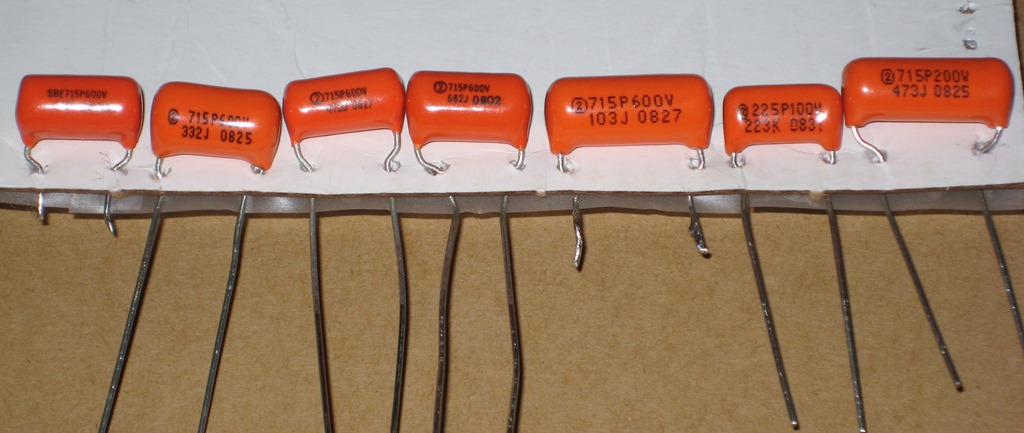 I play through a series of Orange Drop caps with values (pictured right-to-left) .047uF, .022uF, .01uF, 6800pF, 4700pF, 3300pF and 1000pF.
Correction: in the video, at 2:52, I said this incorrectly. The cutoff frequency doesn’t actually change- just the amount of signal passed through the cap to ground. To change the cutoff frequency, pick a different capacitance value. This configuration of resistor and capacitor, in parallel with the guitar signal, makes this a Low Pass RC filter.
Correction: in the video at 4:21, the .022uF cap is a 225p orange drop which is polyester film while the rest are polypropylene.
I purchased these Orange Drops at Mouser – significantly cheaper than at guitar specialty stores.
As with part 1 of this video, everything is played on my Epiphone Riviera P93 with Vintage Vibe Guitars P-90 pickups, through my Vox VT30 on the Boutique Clean model, mic’d with a Rode NT1 large diaphragm microphone.
February 22, 2010 @ 12:09 pm
Fantastic job on these videos. I REALLY appreciate all the trouble you went through and am going to use them as a reference for my first build. This is a topic that was in dire need of some audio/visual explanation. Thanks so much!
February 22, 2010 @ 8:50 pm
A true public service, John. 🙂
Like tone? In depth capacitor comparison: - My Les Paul Forums
February 22, 2010 @ 8:56 pm
[…] Like tone? In depth capacitor comparison: hey guys, Part 2 of John's video is up: Crazy Tone Thing 2: The Sequel lanet z __________________ my wunnerful melody maker (reissue, dual […]
Like tone? In depth capacitor comparison: - My Les Paul Forums
February 22, 2010 @ 9:14 pm
[…] Like tone? In depth capacitor comparison: hey guys, Part 2 of John's video is up: Crazy Tone Thing 2: The Sequel __________________ my wunnerful melody maker (dual pickup, […]
April 2, 2010 @ 8:13 am
Really good video, has made me want to rummage though your archive!
(As a vintage pedal maker, I picked the Russian paper and oil)
February 21, 2011 @ 7:37 am
Hey,
great work, I’ve been searching for something like that for a whole while. Keep the great work up!
Best regards from Germany
April 24, 2011 @ 7:47 pm
All I can say is wow. The Seth Lover (neck) now has its badly needed
treble. And the stock pup in the bridge reduced from very ear shrilling
highs, to something actually desirable. I can dial in alot of tones now.
Also thanks for posting the other video on how to safely remove and install
the electronics. I wouldve never tried to install it myself had it not been
for your videos. You saved me money! Thanks again.
June 23, 2011 @ 3:39 pm
much more common with smaller capacitances, not big capacitances like
you’re describing.
June 24, 2011 @ 10:39 am
low capacitance values. tantalus is .25 uf. Thank you for your attention.
August 9, 2011 @ 11:10 pm
500k pot for volume and 250k for tone and a .22 cap? O.o, do you think it’s
better to use the 250k pot for the volume?, PS: I’m installing a coil split
to the HB 😀 thanks!
September 1, 2011 @ 1:34 pm
use a single push/pull pot for 250k single coil when pushed and 500k
humbucker when pulled. A push/pull is just a standard pot with a switch
attached. See my blog post on 2/16/2011 at planetz for more info on
push/pulls.
September 8, 2011 @ 11:14 am
even just one cap to ground shared by the multiple tone pots. you don’t
need to turn off other two when using one.
September 20, 2011 @ 8:13 pm
marked up, in most places, particularly at Warmoth and Stew-Mac. Allied and
Mouser offer a lot of capacitors, but the “dreaded” x7rs are the easiest to
come by, with np0 and c0gs significantly more expensive. As for pots, the
latter sites don’t have log taper pots in the typical guitar values, and
most other places sell CTS for 5 or more apiece. Orange drop caps seem to
be expensive, anywhere, and vintage? Forget it…
September 25, 2011 @ 9:12 pm
haven’t fired on the purchase yet. They’re just ceramic c0g/np0 caps,
nothing fancy. The most expensive ones were less than $2. But I couldn’t
find any audio taper pots on Mouser; everything seems to be linear. I’ll
check out some of the other sites you mention, though. Thanks for the
information! I appreciate both the videos and the replies; they are quite
helpful.
November 22, 2011 @ 12:58 pm
November 24, 2011 @ 11:47 am
Kondenzátory kytarového zvuku, část 2: Jak funguje tón, výběr hodnoty | ulož to stahuj zdarma
December 9, 2011 @ 9:27 am
[…] https://www.planetz.com/?p=667 . In part two of this video on tone capacitors, I present a tutorial on how to read cap values, an explanation of how the capacitance and resistance work together as an RC filter in the tone circuit, and some audio examples to help in selecting a useful cap value for a tone circuit. The caps I play through here are all Orange Drop polypropylene caps with values .047uF, .022uF, .01uF, 6800pF, 4700pF, 3300pF and 1000pF. Everything is played on my Epiphone Riviera P93 with Vintage Vibe Guitars P-90 pickups, through my Vox VT30 on the Boutique Clean model, mic’d with a Rode NT1 large diaphragm microphone. For a comparison of cap material types, see part one http://www.youtube.com/watch?v=92G-jw4TqS4 Like this video? Please consider making a donation (of any amount) at https://www.planetz.com/?page_id=1272 […]
December 16, 2011 @ 10:41 pm
December 17, 2011 @ 8:42 am
December 26, 2011 @ 1:39 am
December 26, 2011 @ 10:33 am
December 28, 2011 @ 5:14 am
January 1, 2012 @ 2:34 am
January 8, 2012 @ 6:28 pm
January 11, 2012 @ 6:45 pm
January 12, 2012 @ 9:26 am
January 14, 2012 @ 1:45 am
Hello,
Thanks for the video. It is very helpful for the novice building his first guitar. The problem I have run into is that without any type of background the schematic included with my kit may as well be in Greek. Is there a place to see a comprehensive video of wiring two vol., two tone and two hum-bucking pick ups as well as the jack together? Where and how to ground seems so easy until you are faced with it for the first time. Nothing as advanced as you are doing with modifying the tone and such. Which is very cool by the way! Just a good example so I can have benchmark to build upon?
January 16, 2012 @ 1:04 pm
Hi Leonard,
It would be helpful for you to get some basic understanding of how to read the diagrams here at the Guitar Wiring Diagram archive here:
http://www.guitarelectronics.com/category/wiringresources/
These diagrams are more pictorial than a standard electronics schematic- so they show drawings of a pot/switch/cap/etc so you can see exactly how to wire them up.
For example, here’s the link to the standard gibson style 2 humbucker, 2 vol, 2 tone, 3-way switch:
http://www.guitarelectronics.com/product/WD2HH3T22_00/Guitar-Wiring-Diagam-w-2-Humbuckers3-Way-Toggle-Switch2-Volumes2-Tones.html
Each line is a wire. If two wires cross, they’re only connected if there’s a dot at the intersection, otherwise they’re just passing over each other.
To identify your humbucker wires, see this post: https://www.planetz.com/?p=799
Hope this helps,
John
January 14, 2012 @ 7:55 pm
January 20, 2012 @ 12:20 pm
January 26, 2012 @ 8:55 am
January 28, 2012 @ 4:03 am
January 28, 2012 @ 4:08 am
January 31, 2012 @ 10:02 am
January 31, 2012 @ 10:12 am
March 27, 2012 @ 4:29 pm
January 28, 2012 @ 7:13 pm
I really enjoyed this and the first part. Very well presented. You have a gift
for teaching. Thanks 🙂
January 28, 2012 @ 7:22 pm
Just to say Thanks again for taking the time to do this. It is very much appreciated,
I left a comment on the video too, but wanted to say thanks again. I learned a lot.
January 31, 2012 @ 9:25 am
Thanks for the feedback Nicky!
-John
February 4, 2012 @ 4:41 am
February 10, 2012 @ 10:11 pm
February 14, 2012 @ 2:04 pm
February 18, 2012 @ 4:15 pm
March 1, 2012 @ 5:29 am
March 3, 2012 @ 2:34 pm
March 15, 2012 @ 7:56 am
March 15, 2012 @ 8:38 am
March 20, 2012 @ 10:12 am
March 15, 2012 @ 9:52 am
Treble and Bass - Planet Z
March 16, 2012 @ 7:29 pm
[…] my tone capacitor video, I demonstrated the typical use of the capacitor as a low-pass filter in a guitar tone […]
March 17, 2012 @ 3:57 pm
March 22, 2012 @ 9:27 pm
March 22, 2012 @ 7:13 pm
Nice comparisons but I have a few questions and comments with regards to capacitor types and values.
First off I should note that this type of experiment would be more empirical if the guitar were suspended by an armature and plucked by a very steady and well oiled machine in precisely the same string position with pressure and speed being consistent. Secondly, I have to wonder how close your .022 and .047 cap values were in relation to the other caps of same labeled value (were the caps all matched at exactly .022 by meter or were some of them .020, etc…?). It’s great to see more testing being done on such a subjective topic but it would be really great to see someone go the full mile as it hasn’t really been done publicly yet.
I have seen another test online where someone scoped matching value caps with different dialectics. The test showed the different midrange and treble content and how it changed according to the dialectic. Some dialectics rolled off highs/high mids in a more linear vs logarhythmic way and vs/vs. This test was interesting too.
I have a 6 way cap switch and Lawrence Q-Filter in my guitar with 5 caps each containing a different dialectic – The sixth position is no cap, similar to a Gibson varitone. I can tell a difference in terms of midrange and bass and perceived “clarity” of tone. Some caps have a slightly more “granular” quality to the treble while others sound a TINY BIT less sharp. To be honest I probably could not tell the difference accept to say that one is probably an oil in paper cap vs ceramic or chicklet but only side by side with a reference and never alone.
March 25, 2012 @ 10:59 pm
Hi Justin,
Yes, in an ideal world, I’d have a strumming robot that could take out the variable of my hands. Lacking that, I did the best I could with my non-robotic fingers! 🙂
I saw another comparison of different dialectric materials, as I posted here: https://www.planetz.com/?p=726 but he was also was manually strumming/plucking.
I measured the cap values in the followup Q&A in parts 3&4: https://www.planetz.com/?p=709 .
I agree, the differences between dialectric types are pretty subtle. The typical varitone switch has different value capacitances for a range of different filtering- rather than difference dialectrics. But I had the same idea as you that a switch between same values of a couple significantly different dialectric types (like PIO and ceramic) would be useful as another pair of “voices”.
John
April 6, 2012 @ 1:03 am
April 7, 2012 @ 2:32 pm
April 12, 2012 @ 11:21 pm
April 21, 2012 @ 5:35 pm
June 3, 2012 @ 2:19 pm
June 4, 2012 @ 12:52 am
June 8, 2012 @ 11:29 am
June 8, 2012 @ 11:58 am
July 5, 2012 @ 6:09 am
July 14, 2012 @ 4:18 am
July 31, 2012 @ 1:32 pm
August 9, 2012 @ 6:37 pm
August 18, 2012 @ 6:57 pm
August 26, 2012 @ 8:57 pm
September 5, 2012 @ 9:55 pm
September 9, 2012 @ 3:19 pm
September 9, 2012 @ 3:35 pm
September 14, 2012 @ 10:09 am
September 9, 2012 @ 12:27 am
September 9, 2012 @ 3:21 pm
September 21, 2012 @ 11:14 pm
September 25, 2012 @ 10:39 am
October 21, 2012 @ 7:11 pm
October 29, 2012 @ 10:34 am
October 29, 2012 @ 11:26 am
November 1, 2012 @ 11:39 pm
November 2, 2012 @ 9:01 am
An active tone circuit would use an opamp with a cap/resistor network. Search for some schematics and compare passive guitar circuits with active guitar schematics. Even guitars with active preamps sometimes use a passive tone circuit identical to the one shown here.
November 2, 2012 @ 9:10 am
the jack correct?….then showing the + / – would be ideal to get the whole picture. Thank you!
November 2, 2012 @ 9:22 am
For more information, see this article at my blog: search “planetz all about pickup magnets”.
Also, see the FAQ at my blog for some good books to read to help your understanding.
November 2, 2012 @ 9:34 am
November 20, 2012 @ 8:22 pm
December 1, 2012 @ 5:08 pm
December 3, 2012 @ 6:12 am
December 4, 2012 @ 1:12 pm
December 30, 2012 @ 9:49 pm
January 3, 2013 @ 11:42 pm
December 12, 2012 @ 1:15 pm
December 22, 2012 @ 7:25 am
Thanks – very useful info very well presented!
Anonymous
December 22, 2012 @ 7:27 am
[…] thinking of mixing cap values for each pickup) but this guy beat me to it and shares his results at https://www.planetz.com/guitar-tone-c…ors-explained/ Also has links to demos of a range of different cap types in similar fashion. […]
December 25, 2012 @ 1:11 pm
December 25, 2012 @ 1:17 pm
January 2, 2013 @ 8:09 pm
Hey John,
Just caught both videos on YouTube today as I’m finishing up a strat type project. I will be using two humbuckers and a single coil with taps etc. Your videos were very helpful… Thanks for the intel.
Best,
EMH
January 2, 2013 @ 8:22 pm
Cool! Enjoy the new Strat.
John
January 21, 2013 @ 1:20 pm
January 21, 2013 @ 1:22 pm
January 24, 2013 @ 4:25 pm
January 21, 2013 @ 1:23 pm
January 24, 2013 @ 4:32 pm
January 26, 2013 @ 8:46 am
BTW, I use 22nF on a strat and 15nF on a LP style guitar ’cause I don’t like the volume reduction but do like the midrange honk!
January 28, 2013 @ 10:26 am
January 29, 2013 @ 5:17 am
January 31, 2013 @ 10:34 am
January 31, 2013 @ 1:56 pm
February 19, 2013 @ 11:55 pm
February 23, 2013 @ 10:21 am
February 26, 2013 @ 6:34 pm
April 13, 2013 @ 6:11 pm
April 18, 2013 @ 10:36 am
Even in this one I still liked that .0022uF
Regards.
April 18, 2013 @ 10:54 am
Regards
April 26, 2013 @ 10:18 pm
May 3, 2013 @ 3:36 pm
May 8, 2013 @ 7:00 pm
May 9, 2013 @ 12:44 pm
May 14, 2013 @ 8:31 am
June 22, 2013 @ 6:54 am
June 28, 2013 @ 11:37 am
June 30, 2013 @ 12:02 am
July 11, 2013 @ 8:40 am
September 12, 2013 @ 3:08 pm
July 11, 2013 @ 8:30 am
July 15, 2013 @ 10:50 am
July 19, 2013 @ 8:41 pm
September 12, 2013 @ 3:08 pm
September 12, 2013 @ 9:46 pm
September 12, 2013 @ 11:36 pm
October 2, 2013 @ 6:45 am
October 2, 2013 @ 8:35 am
October 27, 2013 @ 10:12 am
October 18, 2013 @ 9:31 am
October 27, 2013 @ 10:09 am
November 6, 2013 @ 12:23 pm
November 10, 2013 @ 4:09 am
November 22, 2013 @ 11:42 am
a thousand words. A lot of internet advice about this is in written
words. How do you explain tone to someone…. Excellent demo! THANKS!
December 9, 2013 @ 2:54 am
i was hearing some nice resonances as the frequencies were reduced and was
a nice subtle taper to my ears. Love the cap rig, shows how important it
is, if you can to customise your caps.
December 19, 2013 @ 3:57 am
capacitors? And Does different Potentiometers on 10 make sound different?
December 19, 2013 @ 4:04 am
bridge pickup dosn’t have enough low. I’m talking about 10 knobs positions.
I thought about changing 57 pickups to burstbuckers. But some guy had the
same problem and it didn’t help. I think it’s in the electronics. So my
previous question about this.
December 19, 2013 @ 9:21 pm
If you are using a 250k pot and go through this process with the tone pot
on 10, do all the different capacitor values sound the same when the pot is
totally open (on 10)? Example: If I have a telecaster with a .022 cap on
a tone pot on 10, will it sound the same as the same tele with a .047 on
the tone pot on 10 as well?
thanks!
December 23, 2013 @ 12:06 am
– Seymour Duncan Hot rodded Humbucker(SH-4 and SH-2). – Potentiometers CTS
with values: 542k, 542k, 560k, 534k.
– Orange Drop capacitors , i bought two 0.022uf and two 0.047uf.
My question is, what potentiometers should I use for the volume and tone?
Should I use the potentiometers with larger values for the volume? And for
the tone what capacitors should i use ?… thank you….
kind of things that I play:
The strokes, Nirvana, Red hot chili peppers, Audioslave, Muse, Pearl Jam,
Radiohead….
February 11, 2014 @ 10:18 am
February 18, 2014 @ 9:49 pm
I noticed more than before when I switch (5-way) from positions some
positions drop off considerably (especially position 2 Humbucker bridge and
North single coil neck combo)…is there a way to keep the switching and
output uniform without effecting the tonal qualities? Love the mod and the
sound it produced…essentially replaced the Alnico V mag. from the bridge
and placed it into the neck and conversely to the Ceramic (ferrous) mag.
from the neck and placed it into the bridge…AWESOME results!!
February 19, 2014 @ 7:59 am
February 22, 2014 @ 10:46 pm
February 23, 2014 @ 10:43 am
You are amazing and I hope you enjoy life knowing you’ve done things to
better the world!
February 25, 2014 @ 12:24 pm
March 7, 2014 @ 11:18 pm
March 21, 2014 @ 5:26 am
what a brilliant explanation you give of everything. You make it very easy
to understand. Thank you
April 7, 2014 @ 10:37 pm
April 21, 2014 @ 8:03 am
May 1, 2014 @ 10:42 am
Very useful information, I commend you for your tireless dedication to
tone, John!
June 2, 2014 @ 9:19 am
knowledge. Now i am gonna make my guitar more brighter using a smaller
value capasitor
June 27, 2014 @ 12:57 pm
June 28, 2014 @ 10:51 am
July 2, 2014 @ 9:23 pm
had a severe case of “Ebay Teisco Fever”. (Also known as Guyatone gout,
Harmony hepatitis, Tulip Tuberculosis, etc.) By the time the “fever” broke,
I had acquired an array of 60’s Japanese electric guitars. Of course, some
of them had no redeeming tonal qualities, so they became wall decorations.
Eventually, I began pulling various parts from them to make one extremely
unique Frankenguitar. This is when I began to wonder how the cap/resistor
values affected tone. Now I know! And knowing is half the battle! Now all I
have to do is wait for a perfectly positioned bolt of lightning . . . I
will let you know how it turns out. Hopefully!
July 13, 2014 @ 3:33 pm
July 16, 2014 @ 4:19 pm
is a lot of difference in the sound but this sure proves them quite
incorrect. Thank you.
August 11, 2014 @ 6:47 pm
August 22, 2014 @ 12:29 am
two years! =D Thanks!
October 1, 2014 @ 12:24 pm
October 3, 2014 @ 4:13 pm
Greatings from Brazil.
October 14, 2014 @ 9:09 pm
EVER SEEN.
Thank you, John!
October 19, 2014 @ 12:40 am
November 10, 2014 @ 6:15 pm
November 28, 2014 @ 9:55 am
it’s the other way round?
November 30, 2014 @ 10:48 pm
configuration, are pretty useless in terms of range, as often going beyond
halfway down it already tends to become pretty much.
I’ve never used my tone-controls that much, but there have been cases that
I could find a nicer sound with it turned down only a fifth or so from all
the way open. In effect I only kind of use 2 or 3 positions.
So, this brings me to a question; Couldn’t I just replace the tone-pot with
a toggle-switch? For example, one position is like the pot would be all the
way open, and another position would be like when the pot would be a
quarter down or something like that.
Or say maybe even a 3-way switch, where position 1 would be no cut-off,
position 2 would be like a value of 3300pF all the way active, and the 3rd
could be 1000pF
If this is a possibility; Would I need to use 2 or 3 capacitors to hook up
to a switch (in which case the switch would probably be used like a
“channel”-switcher), or could I use the capacitor with the largest range
and have a special switch that decides the values like a pot would (but of
course in steps instead of a sweep)?
I would really like something like this, cause using a rotational knob
isn’t that accurate on-the-fly. It might be accurate to find the exact
point you like, but you’re not going to do that while playing actual music.
I’ve tried, and have never been able to really get the right position,
often ending up tinkering with the knob for the rest of the passage in
which I needed the high-cut.
I found a similar problem with this guitar I have that has pots to turn
humbuckers into single coils, which is just so slow compared to a push/pull
or push/push pot. Sure, you get a larger range of sounds with a pot’s full
sweep, but it’s impractical when you’re in the middle of playing music.
Tone-pots are so “primitive” in use. An alternative must be possible, no?
December 2, 2014 @ 3:03 pm
multi-position switch with a different capacitor at each switch position.
Famously used on BB King’s Lucille, but easy enough to retrofit in any
guitar. Search for Varitone
December 7, 2014 @ 4:43 am
December 7, 2014 @ 4:43 am
December 7, 2014 @ 4:47 am
December 7, 2014 @ 4:47 am
December 8, 2014 @ 9:13 pm
December 14, 2014 @ 4:04 am
the circuit electric potential, this spreads and eliminates higher
frequency variations in potential.
February 19, 2015 @ 7:02 pm
still in the dark. I’ll watch this a few times trying to enlighten myself.
February 23, 2015 @ 5:59 am
March 3, 2015 @ 9:03 am
this do anything.. or is it harmful at all
March 12, 2015 @ 2:00 pm
April 25, 2015 @ 7:06 am
second, third harmonic
July 22, 2015 @ 8:08 pm
to explain this type of stuff to people I can just refer them to this
video! I worked on a Gibson varitone just the other week for the first
time. Cool guitar but man what a bunch of knob turning ridiculousness that
was! One of the most useful things I’ve ever used to get the right “boxy”
sound I prefer is by leaving a wah pedal engaged wherever my foot decides
it sounds best. I’m surprised more people don’t do this! Again, great
video. KUDOS
Crazy Tone Thing – Planet Z
May 2, 2017 @ 9:02 pm
[…] of different dialectric material types to see how they change the character of the sound. In part 2, I’ll cover how different capacitance values affect the range and usefulness of the tone […]
Tone Caps Follow-up – Planet Z
May 2, 2017 @ 9:04 pm
[…] I’ve received a lot of questions and comments about my tone cap videos part 1 and part 2. […]
February 16, 2019 @ 6:38 pm
Thanks for this video – helped clarify some things for me. I do have a question though – in general would 3300pf (bridge) and 4700pf (neck) be a strange pairing for a large hollowbody with tv jones classics and 500k pots? I really want to retain the highs and eliminate mud when I use the tone control.
Thanks!!!
February 17, 2019 @ 11:51 am
Hi Robert- I don’t think it would be strange- but there’s only one way to find out if you like it! As always, I recommend experimenting with alligator leads before soldering, to make it easy to swap components to find out what you like.
Enjoy the process!
-John
February 20, 2019 @ 2:23 pm
Thanks – your video REALLY helped:)