Thursday, April 25th, 2013 at 11:54 am
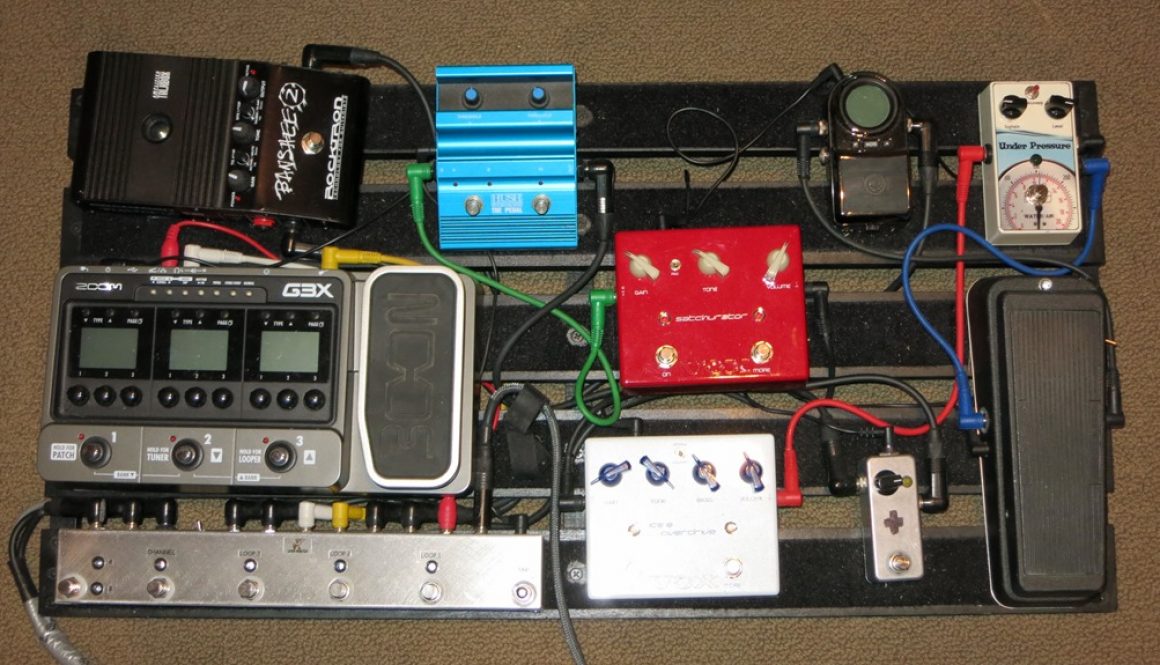
The night before my St Patrick’s Day gig with the Drop Daddies, we were setting up at a rehearsal space for a last minute practice. I powered up my gear, and none of my pedals were working!
After a bit of trial and error, it was clear that my ancient SKB PS-25 pedalboard power supply had finally keeled over. I never use batteries, but fortunately a couple of the pedals had old 9V batteries still in them, so it was enough to scrape by for the rehearsal.
The following morning, just a few hours before the gig, I went through my box of old guitar gear to try to find a replacement 9V DC negative-tip power supply.
Hey, here’s the power supply for my Digitech Jamman Delay which I’m not currently using in my live rig. It says 9V, 1.3A. Strange, it doesn’t show a polarity, but it’s a power supply for a guitar pedal, and the plug barrel fits, so it must be good, right? What could possibly go wrong?
Read the rest of this entry
Tuesday, April 16th, 2013 at 12:04 pm
You wouldn’t believe how often I get asked this, in the comment-responses to my electronics videos. (I’ve just added this to my FAQ)
In the US, solder is pronounced "saw-der" (ˈsɑːdər) without the L. My family is Australian- I grew up doing electronics projects with my Dad, pronouncing it with the L as "sole-der" (ˈsɒldər). I have to really make an effort to say it the American way.
Here’s an interesting etymonline entry that shows the original mid 14th century word was “sawd” with no “L”. It seems unlikely that this is the reason Americans pronounce it without an “L”, but it’s as good an excuse as any 
solder (v.) mid-14c., sawd, from Old French soldure, from solder "to join with solder," from Latin solidare "to make solid," from solidus "solid" (see solid). Modern form is from early 15c. The -l- still is sounded in Great Britain. Related: Soldered; soldering. The noun is first attested late 14c. |
For reference, here is the entry for "solder” in the Oxford English Dictionary, including recordings. The pronunciation with the L is listed as British English, while the other is listed as American pronunciation.
And here’s a fun article about other words with missing L’s.
Thursday, March 21st, 2013 at 8:47 am
Some users of guitar interface cables like my DIY cable project have noticed an unreasonable amount of feedback when using Apple’s GarageBand iPad app.
Good news- Apple rolled out an update to GarageBand yesterday which appears to resolve this.

Thanks PaulB for letting me know!
Wednesday, January 23rd, 2013 at 10:36 am
In this article, Pete Biltoft at Vintage Vibe Guitars gives an in-depth explanation of pickup coil wiring options. Note this information is provided in the context of humbuckers, but applies just as well to a pair of single coil pickups that are RWRP relative to each other. You may also find my earlier posts useful: Humbucker Wiring and Coil Splitting, and Pete’s previous article on Coil Splitting/Tapping.
Thanks again to Pete for the permission to post this here!

January 2013
Howdy!
In this Tech Tips newsletter I would like to discuss the wiring options possible with a single humbucking pickup which has a four conductor output cable with an independent ground lead.
The following information applies not only to conventional humbucking pickups with side by side coils, but also to stacked humbuckers and humbuckers in other size formats or configurations.
In this newsletter I do not plan to cover the details of wiring one or more switches to accomplish the possible coil configurations described below. A great deal of useful information on this topic is provided on the Stewart MacDonald website, the Guitar Nuts website and on www.deaf-eddie.net
First, let’s start with the basics:
Read the rest of this entry
Monday, December 17th, 2012 at 11:12 am
In this final installment on finishing your own guitar effects pedals, I demonstrate how to print and apply the waterslide decal to the pedal, and apply a durable clear finish. In previous videos, I showed how to model, drill, and paint the enclosure, and design and prepare the artwork and labels in GIMP.
I use clear waterslide decal paper, and print on my inkjet Canon Pro9000mkII. After printing, and waiting a while to ensure the ink is dry, I spray on a few coats of Krylon Acrylic Crystal Clear acrylic to protect the ink during the soak. Then, after the clearcoat dries for 30 minutes or so, I trim the paper to final dimensions and soak the paper in warm water. When the decal starts to move freely from its backing, I wet the surface of the enclosure and slide the decal directly onto it. I iron out the bubbles with wet fingers, and adjust the decal into its final position, being careful not to stretch the decal.
Read the rest of this entry
Monday, October 15th, 2012 at 8:48 pm
The next step in finishing up the pedal that we’ve modeled, drilled and painted previously, is to prepare the artwork and labels.
In this tutorial, I will demonstrate how to compose your pedal artwork in GIMP, the free GNU Image Manipulation Program. I’m using GIMP 2.8.2 on Windows, but it also runs on Mac and Linux.
I start with an overview of my Under Pressure compressor and Speed Racer Overdrive artwork, and then show how to compose your own pedal artwork from scratch.
I cover the basics of project setup, layout, working with the rulers and guidelines, the graphics and text editing and selection tools, sourcing artwork and fonts, retouching and removing blemishes, extracting components from a larger image, layer compositing with masks, and more.
Here are some of the resources shown in this video:
Read the rest of this entry
Tuesday, October 9th, 2012 at 5:03 pm

[Update 10/11/2012: What a relief! All my old YouTube comments appear to have been restored successfully. Thanks to the YouTube team for correcting the situation so promptly.]
[Update 10/10/2012: Some news: I received an email from the youtube team saying "A small number of YouTube users may have had their comments deleted as a result of an error on our part". They sent a link to a reinstatement form, which I submitted, and I now wait with fingers crossed for a speedy and successful recovery. Here’s a link to that form, if you feel you’ve also been affected by this issue!]
Today I noticed something completely depressing! I was looking back at some older comments on one of my videos and I noticed that none of my comments were there. When I clicked on someone’s reply to one of my comments “in reply to John Cooper (Show the comment)”, it popped up a dialog saying “The comment no longer exists”.
Read the rest of this entry
Friday, September 7th, 2012 at 7:15 pm
Now that we’ve modeled the enclosure and printed a drilling template, we’re ready to jump out of Sketchup and into the real world.
In this video, I’ll be demonstrating how to accurately drill the holes in a diecast aluminum 125B guitar pedal enclosure, preparing to install the electronics. I’m using the drilling template we printed in part 2. The pedal I’m building is a modified Ross compressor, using a printed circuit board purchased from GuitarPCB.
Funny, I just noticed while reviewing the final video edit that I was saying “barrel” instead of “bezel” for the LED bezel. I guess I was channeling my inner Cooper.
Some of the resources used in this video:
Friday, August 31st, 2012 at 11:10 pm
This is part 2 of my new series on building guitar effects pedals.
This part of the project ended up being far more grandiose than I originally intended. I started out planning to just show how to model this diecast aluminum 125B guitar pedal enclosure, to make sure my PCB and components would fit properly inside. But by the time I was done with it, it was essentially a complete beginner’s how-to course for Google Sketchup. (Note, Sketchup is now part of Trimble instead of Google).
To give you an idea of how long this took for me to complete, I started filming the intro and the Sketchup tutorial videos in June of 2011. Over the last year, in the time-spaces between the rest of life, I’ve been gradually editing, revising, extending, and composing music for the project.
In this tutorial, I start out with the absolute basics, and gradually pick up the pace, progressing to more and more advanced topics. I divided the video up into 5 sections, but kept them all together in one 55-minute video. In my previous multi-part videos, I had to split them into multiple YouTube clips, due to the YouTube length restrictions, but now that they’ve relaxed those for my account- I hope it’ll be better having it all in one video.
Here is the Sketchup file that I used in the tutorial if you’re interested: Download sketchup file.
Each section assumes a familiarity with the previous section topics. Here’s the table of contents:
Read the rest of this entry
Friday, August 31st, 2012 at 8:25 pm
This is the first post in a series on building guitar effects pedals. It’s going to be a bit out of order- I’ll be starting with what is usually considered the finishing touches- putting the pedal in an enclosure, modeling and laying out an enclosure in Google/Trimble Sketchup, drilling the enclosure, painting and finishing it.
Then hopefully later, I’ll go back and do a project showing how to build a simple boost pedal from scratch.
This first video is the motivational intro: here are some of the things I’ve done, and yes, you can too! If you have some interest in electronics and guitars, what better way to improve your knowledge? You can get started with little or no electronics experience, and you’ll learn a bunch along the way.
In part 2, I give a full beginner’s course in Google Sketchup.
Here are some useful links for pedal building:
Read the rest of this entry